
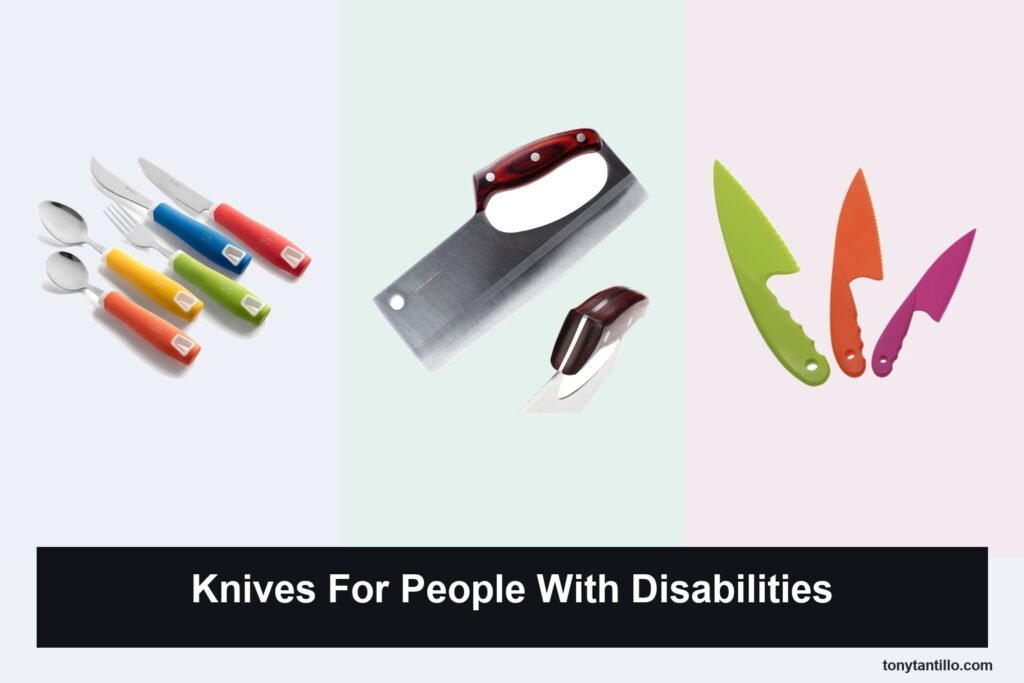
Choosing kitchen knives for someone with limited hand strength, tremors, arthritis, or one-handed cooking is less about style and more about control. The right tool can reduce strain, improve safety, and keep food prep manageable when a standard handle or blade shape becomes difficult to use.
The six options below cover distinct approaches to that problem. Some rely on wider grips, some on rocking motions, and others on safety-forward materials or handle accessories. The key differences are how much grip support they provide, how they behave on the cutting board, and whether they are meant to replace a conventional knife or adapt one already in use.
Top Knives For People With Disabilities on the Market

Special Supplies Adaptive Utensils Set
Best Adaptive Dinner Set
- 5-piece eating set
- Wide non-slip handles
- Stainless steel utensils
- Dishwasher safe
- Adaptive daily dining

HIDAMOS 8.5-Inch Chef Cleaver
Best Precision Cleaver
- 8.5-inch blade
- 5Cr15Mov steel
- Rosewood handle
- Convex small-angle edge
- Forged construction

PENTA ANGEL Plastic Knife Set
Best Safety Starter Set
- 3-piece set
- Plastic serrated blades
- Three sizes included
- Lightweight construction
- Color-coded handles

Hanaive 2-Pack Ulu Rocker Knives
Best Rocking Chopper
- 2-piece rocker set
- 4 x 5 inch size
- Wood handles and base
- Stainless steel blades
- One-handed chopping

Hanaive One-Handed Rocker Knives
Best One-Handed Cutter
- 2-pack adaptive knives
- 8 x 3 inch size
- Stainless steel blades
- Wood handle
- Rocking cut motion

DICEVICE EverGrip Knife Aid
Best Knife Adaptation Aid
- Ergonomic grip accessory
- Flexible polymer build
- Fits most standard handles
- Dishwasher safe
- Right-handed design
Knives For People With Disabilities Reviews
Special Supplies Adaptive Utensils Set
ADVANTAGES
LIMITATIONS
This set is aimed at diners who need more control at the table rather than a specialty prep knife. The broad, non-weighted handles are the main value, because they reduce the need for a tight pinch grip and give the hand more contact area. That matters for tremors, arthritis, and reduced dexterity, where a thin utensil can twist or feel unstable. The five-piece layout also covers more than one meal format, so it works as a practical everyday kit instead of a single-purpose aid.
The stainless steel construction is paired with food-safe silicone handles and dishwasher-safe care, which keeps maintenance straightforward. That combination is important for users who already need tasks to be simpler, because cleanup should not become another obstacle. The set includes a fork, knife, curved knife, dinner spoon, and soup spoon, so the range is broad enough for mixed meals. Since the utensils are not weighted, they are easier to lift repeatedly, though they do not add the stabilizing heft some users prefer.
Among the six products here, this is the most complete replacement for standard flatware use at the table. It is less about slicing performance and more about dependable, low-effort dining. That makes it a strong recommendation for anyone who wants one coordinated set instead of piecing together separate adaptive tools. If the priority is meal-time independence with minimal fuss, this is the clearest all-around choice.
HIDAMOS 8.5-Inch Chef Cleaver
ADVANTAGES
LIMITATIONS
This cleaver is for users who want a more force-efficient cutting tool than a standard chef knife. The 8.5-inch blade and broad cleaver shape reduce the number of strokes needed on vegetables and meat, while the small-angle convex edge is built for sharper contact with food. That combination can matter for someone who needs cleaner cutting with less wrist effort. The rosewood handle also gives the knife a more traditional grip profile than the molded-handle adaptive tools in this roundup.
The forged 5Cr15Mov steel construction is the most important durability detail here. Forging usually signals a more substantial knife body, and the stated edge-retention focus means the blade is intended to stay useful between sharpenings. At 7.36 ounces, it is not the lightest option in this group, so it may feel more substantial in the hand than a rocker knife or plastic training knife. That can help control cuts, but it also means it is less forgiving for users who need extremely low effort.
Compared with the adaptive dinner set and the rocking knives, this is the most conventional cutting tool in the group. It is best for a user who still wants a traditional chef-knife experience but benefits from a design that eases wrist pressure and transfers ingredients easily. It is a stronger choice for prep than for dining, and that tradeoff is what separates it from the more disability-specific options. Choose it when you want a serious kitchen knife rather than a pure assistive utensil.
PENTA ANGEL Plastic Knife Set
ADVANTAGES
LIMITATIONS
This set is the most safety-oriented knife option in the group. The plastic blade material and serrated edge are designed to lower the intimidation factor of kitchen cutting, which is useful for supervised cooking practice or for users who want a gentler-feeling tool. The three sizes also matter because hand size and task size are not the same. A small blade works differently on fruit than a larger one does on bread or vegetables, so the set gives more flexibility than a single knife can.
Light weight is a real advantage here. At 2.88 ounces for the set, the knives are easier to manage than heavier steel cutters, and that can reduce fatigue for users with limited stamina or reduced grip strength. The tradeoff is obvious: plastic will not behave like steel, and the knife is aimed at softer foods rather than demanding prep. The serrated edge can still help with traction, but it does not turn the set into a heavy-duty kitchen tool.
Relative to the adaptive utensils and rocker knives, this set is less specialized for disability support and more focused on safer handling. It works best for users who need a forgiving introduction to kitchen tasks, especially when cutting fruit, vegetables, or bread is the main goal. Because the pieces are simple, light, and size-diverse, this is the easiest recommendation for cautious households. It is not the strongest knife here, but it is the most approachable.
Hanaive 2-Pack Ulu Rocker Knives
ADVANTAGES
LIMITATIONS
The rocker shape is the main reason this set belongs in a disability-focused roundup. Instead of asking the user to drive a straight blade through food, it turns cutting into a rocking motion that can be easier for one hand and less demanding on the wrist. The 4 x 5 inch size is compact enough to feel manageable, and the stainless steel blade gives the set a more durable cutting edge than plastic alternatives. The included wooden bases also make storage more orderly than loose blades in a drawer.
That same shape changes how the knife is used. The curved profile favors chopping herbs, vegetables, salad ingredients, fruit, and softer foods, and it can be especially helpful when the goal is to reduce repeated downward force. The solid wooden handle should feel more substantial than a thin plastic grip, though the set is still not as universally adaptable as a wider handled utensil set. Because the design is specialized, it rewards users who are comfortable with rocker-style cutting.
Against the other products here, this is one of the best options for users who need help with meal prep rather than dining. It is less general-purpose than the chef knife and less conservative than the plastic set, but it offers a meaningful mechanical advantage through motion rather than brute force. That makes it a strong pick for arthritic hands and for anyone who can benefit from controlled rocking instead of vertical chopping. For adaptive prep work, it is one of the smartest choices in the group.
Hanaive One-Handed Rocker Knives
ADVANTAGES
LIMITATIONS
This pair is built around a clear disability-use case. The one-handed rocking motion is intended to lower the effort needed for slicing, dicing, chopping, and mincing, which is especially relevant for users with limited dexterity, Parkinson’s, or arthritis. The 8 x 3 inch size gives the blade enough length to work on meat while still remaining compact enough to control in one hand. That balance is important, because a tool that is too small can feel unstable while one that is too large can be unwieldy.
The stainless steel blade and wood handle make this feel closer to a traditional knife than the more safety-focused plastic set. That usually translates into better durability and a more familiar cutting experience, but it also means the user needs to be comfortable with a pointed, steel utensil. The size note is worth attention as well. It suggests this knife can work in bowls or cans, which expands its usefulness beyond standard cutting boards. That flexibility is a practical advantage for users who manage food with limited hand control.
Compared with the smaller Hanaive rocker set, this model is better for users who want a more meat-oriented adaptive cutter. Compared with the wide-handled utensil set, it is much more specialized but also more capable for actual food prep. The result is a good middle ground for people who need one-handed operation without giving up the feel of a real kitchen knife. For a buyer focused on adaptive slicing and chopping, this is the most direct match.
DICEVICE EverGrip Knife Aid
ADVANTAGES
LIMITATIONS
This product takes a different approach from the rest of the group. Instead of replacing the knife, it changes how the user holds an existing blade. That matters for people who want to keep using a favorite chef knife or santoku but need more comfort and a more stable hand position. The pinch-grip trainer design is especially useful when fine control matters, because it guides the hand into a more consistent hold. For users with arthritis or carpal tunnel, the goal is not a new knife but a better interface with the one already owned.
The flexible polymer and dishwasher-safe construction make it easy to keep in service, and the small 2.6-inch accessory size means it does not add bulk to storage. The key limitation is compatibility. It is designed for right-handed people and fits most standard handles rather than every possible knife shape. That means it is an accessory with a clear use case, not a universal solution. Still, for the right knife and the right user, it can change comfort far more economically than replacing a whole set.
Compared with the other five products, this is the most targeted support tool rather than a complete utensil or knife replacement. That makes it the smartest option for a user who already owns a good knife and mainly needs reduced strain and better guidance. It will not help if the actual knife shape is the problem, but it can be a strong upgrade if grip is the main obstacle. Buy this when your current blade is worth keeping and the challenge is hand position, not the knife itself.
How to Choose Adaptive Knives
The right adaptive knife depends on where the difficulty actually starts. For some users, the problem is gripping a standard handle. For others, it is pushing a blade through food, coordinating a one-handed motion, or staying safe with a tool that is easier to control. That is why this category includes both full utensil sets and more specialized prep tools. A good purchase should match the hand, the meal, and the amount of effort the user can comfortably manage.
Grip Support
Handle shape matters more than many shoppers expect. A wider handle can reduce the pinch force needed to keep a utensil steady, while a grip aid can improve control without replacing the knife itself. For someone with tremors or joint pain, the goal is often less about sharpness and more about reducing the small corrections that drain strength during a meal. A smooth, thin handle can become tiring fast, even if the blade is technically good.
Cutting Motion
Different users benefit from different blade motions. A straight knife is familiar, but it asks the hand and wrist to do more of the work. A rocking knife changes that by turning the cut into a curved motion that can feel easier for one hand or for limited dexterity. Safety-oriented plastic knives are another route when the priority is a more forgiving learning curve rather than maximum cutting power.
Food Types
The foods you cut most often should guide the choice. Softer items such as fruit, vegetables, and bread can work well with lighter or more specialized blades. Meat and denser prep usually demand more edge quality, sturdier construction, or a blade shape that reduces effort over repeated strokes. A knife that performs well on salad ingredients may still feel inadequate for thicker proteins, so the menu matters as much as the handle.
One-handed Use
One-handed operation is a major dividing line in this category. Rocker-style knives and some adaptive utensils are built to reduce the need for a second hand to stabilize the cut. That can be essential for users who cannot hold food steadily or who need to keep one hand free for balance. When one-handed use is the priority, choose a tool whose shape supports the motion naturally instead of relying on grip strength alone.
Cleanup & Storage
Daily convenience affects whether an adaptive knife actually gets used. Dishwasher-safe pieces reduce the work after cooking, while compact tools store more easily and are less likely to clutter a drawer. Larger knives and specialty shapes may cut better, but they can also need more careful storage. If the user already manages several mobility challenges, a low-maintenance tool often matters more than a technically stronger one that is harder to keep accessible.
Adaptive Knives Comparison Table
| Product | Best For | Blade Length | Blade Material | Handle Material | Weight | Color |
|---|---|---|---|---|---|---|
| Special Supplies Adaptive Utensils Set | Best Adaptive Dinner Set | Not Specified | Not Specified | Not Specified | 0.45 kg | Multicolor |
| HIDAMOS 8.5-Inch Chef Cleaver | Best Precision Cleaver | 8.5 inches | Stainless Steel | Rosewood | 7.36 ounces | Silver |
| PENTA ANGEL Plastic Knife Set | Best Safety Starter Set | 11 centimeters | Plastic | Plastic | 2.88 ounces | 3 Colors |
| Hanaive 2-Pack Ulu Rocker Knives | Best Rocking Chopper | Not Specified | Stainless Steel | Wood | 0.32 kg | Brown |
| Hanaive One-Handed Rocker Knives | Best One-Handed Cutter | 8.07 inches | Stainless Steel | Stainless,Steel,Wood Handle | 9.92 ounces | Silver/Black |
| DICEVICE EverGrip Knife Aid | Best Knife Adaptation Aid | 8 picometer | Ceramic | Rubber | 2.4 ounces | Black |
How We Tested & Analyzed Knives for People with Disabilities
This roundup was organized around the practical obstacles that most often affect knife use in disability-focused cooking and dining. I compared grip style, cutting motion, blade construction, tool size, and cleanup burden because those factors determine whether a knife is merely usable or genuinely helpful. The emphasis stayed on how each design changes effort, control, and everyday handling rather than on cosmetic differences or marketing language.
The comparison also separated category roles. Some products are built for table use, some for prep work, some for one-handed chopping, and one for adapting an existing knife. Those are not interchangeable jobs, so the analysis focused on matching tool design to the task it can realistically improve. Where a product had a clear limitation, such as hand orientation, blade material, or specialization, that limitation was treated as part of the buying decision rather than as a flaw to ignore.
I also weighed how much setup a user might need before the knife becomes useful. Simpler, lower-maintenance tools often matter most when dexterity is already limited, while more specialized tools can be worthwhile when they solve a specific movement problem well. Because the category includes both assistive utensils and adaptive cutting tools, the review framework focused on fit, comfort, and operational tradeoffs instead of trying to force a single ranking standard across every design.
Frequently Asked Questions
What matters most when choosing an adaptive knife?
Start with the movement that is hardest for the user. If grip is the issue, look for wider handles or a grip aid. If cutting force is the issue, a rocker shape or a more substantial blade may help more. The best choice is the one that reduces the specific motion that causes fatigue or loss of control.
Are rocker knives better than regular chef knives?
They are better for some users, not everyone. A rocker knife reduces the need for repeated straight downward cuts, which can help with one-handed use and limited wrist strength. A regular chef knife still makes more sense if the user wants versatility and already has enough control to guide a traditional blade comfortably.
Should I choose steel or plastic blades?
Steel is usually the better choice for durability and stronger cutting performance. Plastic can be a smart option when safety, light weight, or a gentler learning curve matter more than power. For softer foods and supervised use, plastic can be enough. For frequent prep work, steel is usually the more capable material.
Can a grip accessory replace an adaptive knife?
Sometimes, but only when the main problem is how the knife is held. A grip accessory can improve control on a knife the user already likes, which is useful when the blade itself is still a good fit. It will not solve every issue, especially if the user needs a different cutting motion or a safer blade style.
Final Thoughts
Adaptive knives are worth buying when they reduce a real barrier instead of simply looking specialized. The strongest choice depends on whether the user needs better grip, easier rocking motion, safer materials, or help with an existing knife. Once that problem is clear, the decision becomes much easier, and the right tool can make meal prep or dining feel less demanding and more predictable.
For a full table setting, the wide-handled utensil set is the most complete option. For prep work, the rocker knives and the more traditional forged cleaver solve different problems, while the plastic set is the safest starter choice. The grip accessory fills a different role entirely by improving an already-owned knife. Choose the design that matches the user’s actual motion challenge, and the tool is far more likely to earn its place in daily use.