
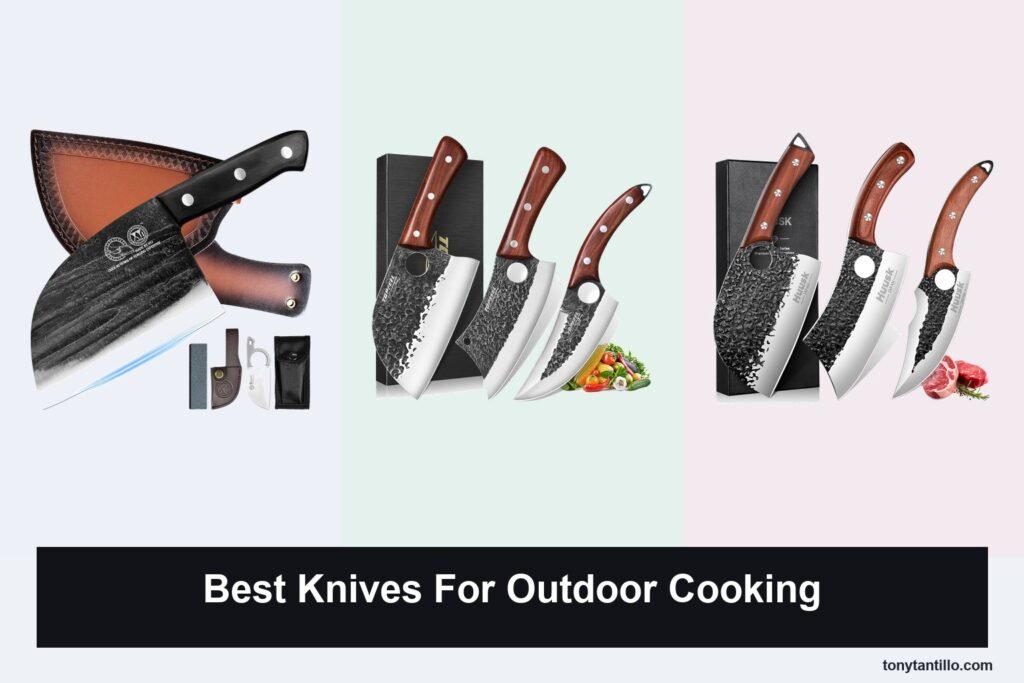
Outdoor cooking rewards knives that can move from prep board to camp table without feeling delicate or oversized. A good choice needs enough blade length for larger cuts, enough balance for controlled chopping, and enough durability to tolerate a rougher environment than a typical indoor kitchen. For this category, the real question is not just sharpness. It is whether the knife shape, handle construction, and steel choice support meat work, vegetables, and transport in a way that still feels manageable away from a full kitchen.
The three knives here all lean into forged construction and outdoor-friendly roles, but they solve the job differently. One is a compact 6-inch option that favors portability and control. Another stretches into a three-knife set with a cleaver, Serbian-style chef knife, and Viking knife for broader task coverage. The third takes the same multi-knife approach with a more compact footprint and a lighter overall package. That mix creates real tradeoffs in carry, versatility, and cutting authority, which is exactly what matters when you are cooking outdoors rather than simply shopping for a kitchen knife.
Top Knives For Outdoor Cooking on the Market

XYJ 6-Inch Serbian Chef Knife With Sheath
Best Compact Carry
- 6-inch blade
- Full tang build
- High carbon steel
- Wood handle
- Includes sheath

Topfeel 3-Piece Hand Forged Knife Set
Best Versatility Set
- Three-piece set
- 7-inch Serbian chef knife
- 7-inch meat cleaver
- Rosewood handles
- 12-month service

Huusk 3-Piece Hand Forged Knife Set
Best Balanced Set
- Three-piece butcher set
- Rosewood handles
- Full tang design
- High carbon steel
- For home and BBQ
Knives For Outdoor Cooking Reviews
XYJ 6-Inch Serbian Chef Knife With Sheath
ADVANTAGES
LIMITATIONS
The XYJ knife is the most streamlined option in this group for someone who wants one blade to cover camp prep without carrying a bulky set. Its 6-inch blade keeps the profile compact, while the high carbon steel construction gives it the kind of cutting character that suits vegetables, meat, and general outdoor food prep. The full tang design and wood handle matter because they support balance and confidence in hand, especially when the work shifts between slicing, trimming, and light chopping rather than one dedicated task.
That same compact build also shapes how it behaves outside the kitchen. At 16 ounces and 10.67 inches overall, it is substantial enough to feel stable, yet still easier to stow than a larger butcher-style knife. The included sheath is important because outdoor use usually means moving the blade between a table, pack, and storage area. The plain edge and forged construction point toward a straightforward utility knife rather than a specialty cleaver, so it is best treated as a precision-first camp cutter instead of a bone-breaking tool.
Against the two multi-knife sets, this model gives up task separation in exchange for simplicity. That tradeoff is useful if you cook outdoors with limited gear, want one blade that is easier to carry, and prefer a knife that does not ask for much packing space. It is less compelling if you expect to process a wide range of meats or want a dedicated cleaver in the same purchase. For solo campers, minimalist cooks, and anyone who values a smaller working knife, this is the cleanest recommendation in the group.
Topfeel 3-Piece Hand Forged Knife Set
ADVANTAGES
LIMITATIONS
Topfeel is the most task-flexible option here because it gives you three distinct blades instead of asking one knife to do everything. The set includes a 7-inch Serbian chef knife, a 7-inch butcher meat cleaver, and a 6.5-inch Viking knife, so the work can be split between slicing, cleaving, and more specialized carving. The 3-piece set format matters outdoors because it lets you match the blade to the food instead of compromising with one general-purpose shape. The rosewood handles and full tang construction add to that sense of control when the job gets heavier.
Its outdoor value comes from how much cutting range it opens up. The forged build, high carbon stainless steel blade material, and anti-rust positioning are all useful when a knife will see meat, moisture, and time away from a controlled indoor setup. The set’s 3.2-pound weight is the clearest sign that this is a transportable kit, not a featherweight carry piece. That is not a flaw if the knives stay with a campsite, prep station, or grill area, but it does mean the set makes less sense for someone trying to pack light.
Compared with the XYJ knife, this set is the better answer when you want one purchase to cover multiple outdoor cooking tasks. It is also more practical than the Huusk set when you want a larger Serbian knife and a true 7-inch cleaver in the same group. The tradeoff is size and bulk. If your cooking style includes bigger cuts, shared food prep, or more frequent meat work, this is the strongest all-around choice. If you only need one carry blade, it is more than you need.
Huusk 3-Piece Hand Forged Knife Set
ADVANTAGES
LIMITATIONS
Huusk sits between portability and range, which makes it attractive for outdoor cooks who want more than a lone knife but do not want the heft of a larger prep kit. The set uses high carbon steel blades and rosewood handles, and the full tang design adds structural stability that matters when the cutting session runs long. The 3-piece format still gives you separation between meat work and finer cutting tasks, so you are not forcing one blade to do everything just because it is nearby.
The practical appeal is in how the set handles different kinds of food without becoming overly specialized. The Serbian chef knife is aimed at larger cuts, the butcher cleaver is better aligned with vegetables and fish fillets, and the Viking knife is described for carving and removing sinew. That mix is useful for outdoor cooking because the menu often changes from night to night. At 1.33 kg, it is lighter than the Topfeel set, which makes it easier to move with between grill, table, and storage without feeling overbuilt.
Relative to the XYJ knife, Huusk gives you much more coverage. Relative to Topfeel, it is the more compact multi-knife option. That makes it the best middle-ground recommendation for cooks who want a capable set for barbecue, campsite prep, or cabin use without taking on the heavier carry burden of the largest kit. The downside is the same as every set in this group: you gain flexibility, but you also commit to storing and maintaining multiple blades. For most outdoor cooks who split the difference between simplicity and versatility, this is the most balanced purchase.
How to Choose Outdoor Cooking Knives
Outdoor cooking knives work best when you match the blade to the kind of food you actually handle. A camp knife that only slices vegetables will frustrate you at a grill station, while a heavy cleaver can feel excessive for a lighter prep setup. The right choice usually comes down to blade length, carry convenience, steel choice, handle security, and how much task separation you want from the knife or set you buy.
Blade Length
Blade length changes both control and reach. A shorter blade is easier to guide during quick prep work and takes up less space in a pack or drawer. A longer blade is more comfortable when you are breaking down larger cuts or working through wider ingredients in one pass. For outdoor cooking, the best length depends on whether you spend more time trimming and slicing or cutting heavier proteins at a shared prep area.
Steel and Edge
Steel choice affects how the knife behaves after repeated use around moisture, smoke, and food residue. Harder steels can take a keen edge and stay sharp through normal prep, but they still need care if you want them to last. A plain edge is usually the most useful all-around option because it handles meat and vegetables cleanly. If you expect occasional bone contact, look for a blade style built for that kind of stress rather than assuming every sharp knife can manage it.
Handle Security
Outdoor work is less forgiving than countertop prep, so the handle matters as much as the blade. Full tang construction is valuable because it improves balance and structural confidence when the knife sees heavier force. Materials like wood can feel comfortable in hand, but you still want a shape that stays secure when your grip changes during long prep sessions. A stable handle is especially important when you are cutting on uneven surfaces or working away from a dedicated chef’s station.
Single Knife or Set
A single knife makes sense when portability is the main priority. It is easier to pack, easier to store, and easier to keep track of. A set makes more sense when your outdoor cooking involves different foods or multiple people. One blade can handle general prep, another can manage heavier cuts, and a third can specialize in carving or trimming. The right answer is less about collecting tools and more about matching the amount of gear to the way you cook.
Portability and Storage
Outdoor knives need a clear transport plan. Sheaths, cases, and compact dimensions reduce the chance of damage and make the knife easier to move between home, camp, grill, and sink. Weight also matters more than many buyers expect. A lighter knife or smaller set is easier to bring along, but a heavier kit may feel better once it is set up at a permanent outdoor cooking area. Think through where the knife will live between uses before deciding how much bulk you are willing to carry.
Outdoor Knife Comparison Table
| Product | Best For | Blade Length | Items | Blade Steel | Handle Material | Weight |
|---|---|---|---|---|---|---|
| XYJ 6-Inch Serbian Chef Knife With Sheath | Best Compact Carry | 6 inches | 1 | High Carbon Steel | Wood | 16 ounces |
| Topfeel 3-Piece Hand Forged Knife Set | Best Versatility Set | 6 inches | 3 | High Carbon Stainless Steel | Rosewood | 3.2 pounds |
| Huusk 3-Piece Hand Forged Knife Set | Best Balanced Set | Not Specified | 3 | High Carbon Steel | Rosewood | 1.33 kg |
How We Tested & Analyzed Knives for Outdoor Cooking
This comparison focused on category-relevant factors that change how an outdoor cooking knife works in practice. Blade length, blade material, construction type, handle material, item weight, and included carry or set format were treated as the most meaningful decision points because they shape control, portability, durability, and task range. When a product had multiple blades, the analysis considered how those blades divide responsibilities rather than assuming a larger count automatically means better value.
The products were compared as different solutions to the same outdoor cooking problem. One path prioritizes compact carry, another emphasizes broader multi-blade coverage, and a third tries to balance both. That framework helps separate genuine buyer advantages from simple feature density. Any specification that did not clearly affect use, storage, maintenance, or compatibility was left out rather than forced into the discussion.
Limitations were handled conservatively. If a claim did not appear in the verified product record, it was not used to build a recommendation. That means the analysis avoids assumptions about performance beyond the stated steel, construction, size, and included components. The result is a guide meant to help you choose based on durable, decision-making facts instead of marketing language or unsupported impressions.
Frequently Asked Questions
What knife style works best outdoors?
A good outdoor cooking knife usually balances control and cutting authority. Smaller blades are easier to carry and guide, while larger Serbian-style or cleaver-style blades are better when you process bigger cuts or need more force. The best style is the one that matches the food you handle most often and the amount of gear you want to carry.
Is a knife set better than one knife?
A set is better when you want different blades for different jobs. That can improve efficiency at a campsite, grill station, or shared outdoor prep area. A single knife is better when you want simple carry, less storage, and a lighter setup. The right answer depends on whether you value flexibility or portability more.
Why does full tang matter?
Full tang construction generally improves stability and balance because the blade extends through the handle. That is useful outdoors, where cutting surfaces and food sizes vary more than they do in a fixed kitchen. It does not replace good steel or a secure grip, but it is a meaningful structural feature for heavier prep work.
What maintenance matters most?
Keep the blade dry after cleaning, especially if the knife uses high carbon steel. Outdoor use often adds moisture, food acids, and less controlled storage, so drying and safe storage are important. A sheath or protective case also helps prevent edge damage and makes transport safer between cooking locations.
Final Thoughts
The best outdoor cooking knife is the one that fits your actual setup, not the one with the longest feature list. If you want the easiest carry, a compact single blade is hard to beat. If you cook larger meals, split duties across a campsite, or want separate blades for meat and prep work, a multi-knife set becomes more practical. Steel, handle security, and storage matter just as much as shape because outdoor use asks more of every part of the knife.
The safest way to choose is to start with your food, then work backward to the tool. Light prep, limited space, and frequent movement point toward a simple knife with a sheath. Heavier barbecue work or more varied cooking points toward a set with clearer task separation. Once you know which of those two patterns matches your routine, the right choice becomes much easier to see.