
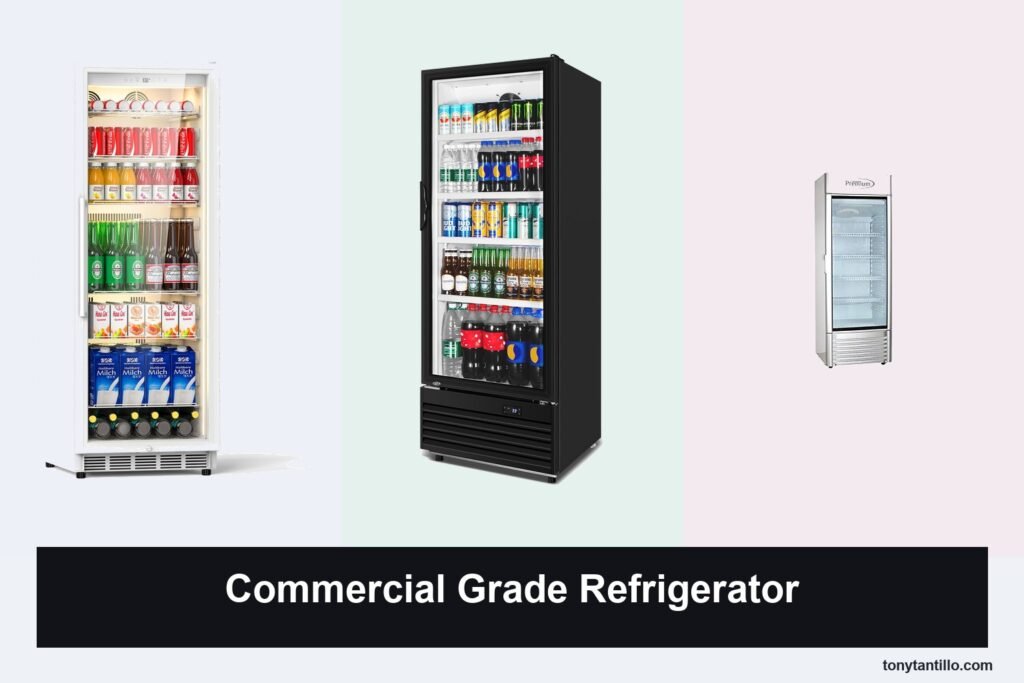
A commercial grade refrigerator has to do more than hold cold air. It has to stay visible, recover temperature quickly after constant door openings, and fit into a business workflow without becoming a maintenance problem. In a shop, café, office, or bar, the wrong unit creates bottlenecks. Drinks warm up too fast, shelves waste space, and noisy operation becomes another distraction in a busy room.
The strongest options balance capacity, temperature stability, glass-door visibility, and practical installation details. For this roundup, the most important differences are not just size and price. Door behavior, shelf flexibility, cooling system design, noise level, and durability in high-traffic spaces all matter. The five refrigerators below cover a useful range of capacities and use cases, from compact display units to larger merchandisers built for continuous access.
Top Commercial Grade Refrigerator on the Market

Velivi 13.8 Cu. Ft. Merchandiser Fridge
Best Large Display Fridge
- 13.8 cubic feet capacity
- LED lighting display
- Low-e double glass door
- Automatic closing door
- 115 volts

Velieta 15 Cu. Ft. Beverage Refrigerator
Best High-Capacity Pick
- 15 cubic feet capacity
- 4 removable wire shelves
- Self-closing glass door
- Digital temperature control
- Front ventilation

PremiumLevella PRF90DX 9 Cu. Ft. Display Cooler
Best Certified Display Cooler
- 9 cubic feet capacity
- ETL and NSF/ANSI 7
- Manual defrost
- Key lock
- Customizable lightbox

ICEVIVAL 6 Cu. Ft. Beverage Fridge
Best Compact Cooler
- 6 cubic feet capacity
- Below 40dB operation
- Double-tempered glass door
- Three adjustable shelves
- ETL certified

ICEVIVAL 8.5 Cu. Ft. Display Fridge
Best Mid-Size Display
- 8.5 cubic feet capacity
- Four adjustable shelves
- Below 40dB operation
- Double UV-resistant glass
- Key lock
Commercial Grade Refrigerator Reviews
Velivi 13.8 Cu. Ft. Merchandiser Fridge
ADVANTAGES
LIMITATIONS
The Velivi Commercial Merchandiser Refrigerator Display Beverage Fridge is the largest display option in this group, and that matters if you need a unit that can stay stocked through a long service window. Its 13.8 cubic feet capacity and claimed ability to show 630 standard cans point to a merchandiser built around volume, not just convenience. LED lighting and the glass front keep inventory visible, so staff can spot what needs restocking without opening the door and losing cold air. That combination suits beverage-heavy counters, restaurant corners, and office refreshment areas that need quick access all day.
Its operating profile is also aimed at everyday commercial use. The compressor cooling method and turbo fan are designed for fast recovery after repeated openings, while the low-noise claim is important in places where the refrigerator sits near customers or workers. The low-e double glass door addresses a real display-refrigerator problem by reducing condensation and frost on the viewing surface. The automatic closing door is another practical detail because it limits cold-air loss when employees are moving quickly. The advertised 37°F to 65°F range is broad enough for merchandised beverages, but buyers should still treat it as a beverage display solution rather than a general food-storage cabinet.
Against the smaller options here, this model is the strongest choice when sheer display volume and easy visibility matter more than minimal footprint. It also stands out for the thicker anti-rust steel frame and the one-year whole-machine warranty with lifetime technical support, which gives it a more businesslike service profile than a basic retail cooler. The tradeoff is size and weight. At 198 pounds and a built-in installation type, it is not the easiest refrigerator to reposition. Choose it if you want a high-capacity merchandiser for frequent access and professional presentation, and skip it only if you need a lighter free-standing unit with simpler placement.
Velieta 15 Cu. Ft. Beverage Refrigerator
ADVANTAGES
LIMITATIONS
The Velieta 24.5″ 15 Cu. Ft. Commercial Beverage Refrigerator is the capacity leader in this lineup, and that extra space changes how a business can stage inventory. Its 15 cubic feet capacity and 500-can claim make it a better fit for locations that need a larger buffer between restocking runs. Four removable wire shelves let you rework the interior for bottles, cans, or mixed package sizes. That flexibility matters in offices, retail counters, and hospitality spaces where beverage demand rarely stays uniform from day to day.
The operational features lean toward low-maintenance service. Automatic defrost reduces the chore of managing frost buildup, and the double-glazed glass, sealing strip, and insulation layer are all aimed at holding the cabinet in the 32°F to 41°F range. The self-closing door is useful in busy environments because it helps reduce the number of partially closed openings that waste cold air. Rear wheels simplify repositioning for cleaning or layout changes, and the front ventilation detail is useful when the refrigerator needs to live closer to a wall or inside a tighter service area.
This is the most storage-forward option here, but it is not the simplest or lightest. At 152.1 pounds, it is still substantial, though easier to move than the larger Velivi unit. Its freestanding and built-in flexibility is a strong advantage for buyers who may need installation options. Compared with the smaller commercial display refrigerators in this group, it gives you the most room before you hit the next size class. That makes it the best match for operators who prioritize inventory depth and interior flexibility over compactness. If you want one refrigerator to handle heavier beverage traffic, this is the one to start with.
PremiumLevella PRF90DX 9 Cu. Ft. Display Cooler
ADVANTAGES
LIMITATIONS
The Premium PremiumLevella PRF90DX occupies a different lane from the bigger beverage merchandisers because it is built around certified display use rather than maximum capacity. Its ETL, NSF/ANSI 7 compliance is a meaningful differentiator for buyers who need a unit that aligns with commercial display expectations. At 9 cubic feet, it is smaller than the two Velivi and Velieta models, but that size also makes it easier to slot into tighter floor plans. The glass door and customizable lightbox support front-of-house presentation, so it is better suited to merchandising where appearance matters as much as storage.
The manual defrost system deserves attention because it changes the maintenance routine. Manual defrost is not as convenient as frost-free operation, but it can be acceptable in lower-volume environments where the cabinet is not being opened constantly. The wire shelving, key lock, and single-door layout keep the refrigerator straightforward to use. Since it is freestanding, placement is simpler than with a built-in unit, and the 115-volt electrical requirement fits standard commercial and residential-style circuits in many settings. The included tools also suggest a more traditional install-and-set-up process rather than a highly complex assembly.
Compared with the larger, more automation-heavy refrigerators in this group, this model is the compliance-minded choice. It is not the biggest, and it does not promise the same maintenance convenience as frost-free units, but it gives you a credible middle ground between presentation and code-conscious use. The 1-year limited parts and labor warranty is shorter than the best warranty in the lineup, so it is less compelling for buyers who want extended coverage. Still, for small commercial displays, break rooms, or mixed-use spaces where certification and visibility carry real weight, it is the most disciplined pick here.
ICEVIVAL 6 Cu. Ft. Beverage Fridge
ADVANTAGES
LIMITATIONS
The ICEVIVAL 6 Cu.Ft Commercial Beverage Fridge with Glass Door is the compact option in this group, and its value comes from efficiency of space rather than brute capacity. At 6 cubic feet, it is sized for smaller counters, offices, or back-bar areas where every inch matters. The claim of 240 cans shows that even a smaller cabinet can still serve a meaningful beverage load. The double-tempered glass door and key lock add durability and security, which are the two things small commercial units often need most when they are placed in shared spaces.
Its operating details are well suited to quieter environments. The below-40dB claim is useful in offices, dorm-like settings, or customer-facing areas where compressor noise can become noticeable. The 170W compressor and 32°F to 50°F range point to a straightforward chilled-beverage application rather than a more general-purpose refrigeration system. Three adjustable chrome shelves add flexibility for taller bottles, and the ETL and ISTA-6A notes are useful for buyers who care about safety and shipping protection. The upright-for-24-hours instruction before first use is a normal setup consideration for compressor equipment and should be built into delivery planning.
This model is the easiest recommendation for buyers who want a small commercial cooler without overspending on capacity they will not use. It does not try to compete with the larger display units on storage volume, but it does offer a sensible balance of size, security, and quiet operation. The tradeoff is obvious. You give up room, but you gain a unit that can fit into tighter spaces and still look professional. If your goal is a compact beverage refrigerator for light commercial duty, this is the most practical entry in the roundup.
ICEVIVAL 8.5 Cu. Ft. Display Fridge
ADVANTAGES
LIMITATIONS
The ICEVIVAL 8.5 Cu.Ft Commercial Display Fridge with Glass Door sits in the sweet spot between compact convenience and larger merchandiser capacity. Its 8.5 cubic feet capacity and 336-can claim make it large enough for steady beverage turnover without pushing into the size and weight of the biggest units. Four adjustable shelves are a meaningful advantage at this level because they let you reconfigure the interior for tall bottles or denser can storage. For cafés, offices, or bars that need visible cold storage without a huge footprint, this size is easier to justify than a larger cabinet.
The refrigeration package is built for everyday commercial use. The below-40dB operating claim keeps noise in check, and the 240W compressor suggests enough cooling capacity for a cabinet in this size class. Four adjustable shelves also give it more internal organization than the 6-cubic-foot model, while the key lock helps control access when the refrigerator sits in a public or semi-public zone. The double UV-resistant glass door is another functional detail because it helps protect the contents from light while reducing the cold air leakage that can happen with weaker glazing.
Among the five refrigerators here, this is one of the most balanced choices because it does not force a buyer to choose between a tiny footprint and a very large cabinet. It is smaller than the 13.8- and 15-cubic-foot models, but the extra shelf count makes it easier to merchandise inventory neatly. Compared with the 6-cubic-foot ICEVIVAL, it gives you more room to grow. Compared with the larger display refrigerators, it is easier to place and less imposing in a customer area. That makes it the best all-around option for buyers who want a mid-size commercial display refrigerator that still feels manageable.
How to Choose a Commercial Grade Refrigerator
The right commercial grade refrigerator depends on how hard it will be worked and where it will live. A unit in a quiet office pantry has different priorities from one at a bar or restaurant counter. Capacity matters, but so do visibility, door behavior, noise, and whether the cabinet can recover temperature after frequent openings. The best purchase is usually the one that matches your service pattern instead of chasing the biggest number on paper.
Capacity and Footprint
Start with the amount of cold storage you actually need during a busy period, not your average day. A display refrigerator that is too small becomes a constant restocking chore, while one that is too large can waste floor space and create awkward traffic flow. Think in terms of how many bottles or cans need to stay ready at once, then translate that into cabinet size. In commercial settings, the right capacity is often the one that reduces interruptions without taking over the room.
Glass Door Visibility
Glass-front refrigerators do more than look polished. They let staff and customers see inventory without opening the door, which can reduce temperature loss and speed service. That matters most when drinks are sold quickly or when a display is meant to encourage self-serve selection. Look for door glazing that is designed to limit condensation or unwanted heat transfer, because a cloudy door undermines both presentation and efficiency.
Cooling and Recovery
Commercial use is hard on a compressor because the door may open dozens of times a day. A refrigerator with quick recovery is easier to keep in its target range after service rushes or repeated grabs from staff. If the cabinet is going to sit in a warmer room or near the front of a business, cooling strength matters even more. Stable temperature is the difference between a display that stays dependable and one that slowly falls behind during peak hours.
Noise and Placement
Noise becomes important as soon as the refrigerator sits near people. A unit in an office, reception area, or seating zone should be much quieter than one hidden in a back prep room. Placement also affects installation. Freestanding models are usually easier to reposition, while built-in or front-venting units can make tighter layouts more practical. Before buying, measure the full path as well as the final spot, including door swing and clearance for cleaning.
Shelves and Access
Shelf design has a direct effect on how useful the refrigerator feels once it is in service. Adjustable shelving gives you more control over tall bottles, mixed packs, and odd-shaped merchandise. Wire shelves are common because they let cold air move through the cabinet, but they also mean you should think about how items will sit and whether smaller packages need extra organization. In a commercial setting, the best shelf layout is the one that cuts down on clutter and speeds restocking.
Security and Maintenance
Door locks, self-closing doors, and frost-free operation may seem like small extras, but each one reduces friction in daily use. A lock matters when the refrigerator is in a shared space. A self-closing door helps prevent the easy mistake of leaving the cabinet half open. Frost-free or automatic defrost systems reduce maintenance time, while manual defrost can still work if the unit is not heavily cycled. Choose the combination that matches your staff discipline and service schedule.
Comparison Table
| Product | Best For | Capacity | Voltage | Cooling Method | Defrost | Warranty |
|---|---|---|---|---|---|---|
| Velivi 13.8 Cu. Ft. Merchandiser Fridge | Best Large Display Fridge | 13.8 cubic feet | 115 volts | Compressor | Automatic115 | 2 Year |
| Velieta 15 Cu. Ft. Beverage Refrigerator | Best High-Capacity Pick | 15 cubic feet | 115 volts_of_alternating_current | Compressor | Frost Free | 1 Year |
| PremiumLevella PRF90DX 9 Cu. Ft. Display Cooler | Best Certified Display Cooler | 9 cubic feet | 115 volts | Compressor | Manual Defrost | 1-Year Limited Parts and Labor |
| ICEVIVAL 6 Cu. Ft. Beverage Fridge | Best Compact Cooler | 6 cubic feet | 110 volts | Compressor | Frost Free | 1 Year |
| ICEVIVAL 8.5 Cu. Ft. Display Fridge | Best Mid-Size Display | 8.5 cubic feet | 115 volts | Compressor | Frost Free | 1 year |
How We Tested & Analyzed Commercial Grade Refrigerator
This comparison focused on practical commercial decision points: storage volume, door visibility, compressor-based cooling, defrost behavior, access control, installation type, and the likely impact of noise in shared spaces. Those factors matter because a business refrigerator succeeds or fails based on how well it fits daily traffic, not just on static capacity figures. I favored verified details that affect operation, upkeep, and placement over generic marketing language.
When multiple models shared similar basics, I separated them by the details that change ownership experience. That included shelf flexibility, self-closing doors, glass construction, certification markers, and warranty coverage. I also treated size and weight as decision factors because they affect whether a cabinet can be placed in a tight service area, moved for cleaning, or integrated into a front-of-house layout. The goal was to compare refrigerator use cases, not just display specifications.
Limitations matter as much as strengths in this category. Manual defrost demands more upkeep than frost-free systems. Larger built-in units can be harder to reposition. Smaller cabinets can be easier to place but may force more frequent restocking. Where a product record did not clearly support a claim, I left it out rather than stretching the interpretation. That keeps the recommendations grounded in the features that actually influence buying confidence.
Frequently Asked Questions
What makes a refrigerator commercial grade?
A commercial grade refrigerator is built for heavier day-to-day use than a typical household unit. In practice, that usually means stronger cooling recovery, more durable construction, better visibility for merchandise, and features such as locking doors, adjustable shelving, or frost-management systems that help it keep working in busier environments.
Is a glass door a good idea for business use?
Usually, yes, when the goal is display and fast access. A glass door lets people see what is inside without opening the cabinet, which can help reduce cold-air loss and speed selection. The tradeoff is that the door needs good glazing and sealing to stay efficient and avoid condensation issues.
Should I choose frost-free or manual defrost?
Frost-free or automatic defrost is easier to live with in a busy business setting because it reduces upkeep. Manual defrost can still work well for lighter traffic or lower-volume use, but it means more maintenance responsibility. If the refrigerator will be opened often, frost-free usually saves time and hassle.
How important is shelf adjustability?
Very important if you store mixed beverage sizes or want the cabinet to stay organized as inventory changes. Adjustable shelves let you create taller spaces for bottles or tighter spacing for cans. That flexibility usually matters more than buyers expect, especially in small commercial refrigerators where every inch has to work efficiently.
Final Thoughts
The best commercial grade refrigerator is the one that matches your traffic, layout, and maintenance tolerance. If you need a large display unit, a mid-size merchandiser, or a compact refrigerator for a tighter space, the strongest options in this group each solve a different business problem. The most important decision is not just how much fits inside, but how well the unit supports service without creating extra work.
For buyers who care most about practical performance, start with capacity, then weigh temperature recovery, door behavior, and how much upkeep you are willing to manage. A quieter unit can be better for customer-facing spaces. A certified display model can matter more in regulated environments. A frost-free cabinet can save time every week. Choose the refrigerator that fits the room and the workflow, and it will feel like part of the operation instead of another obstacle.