
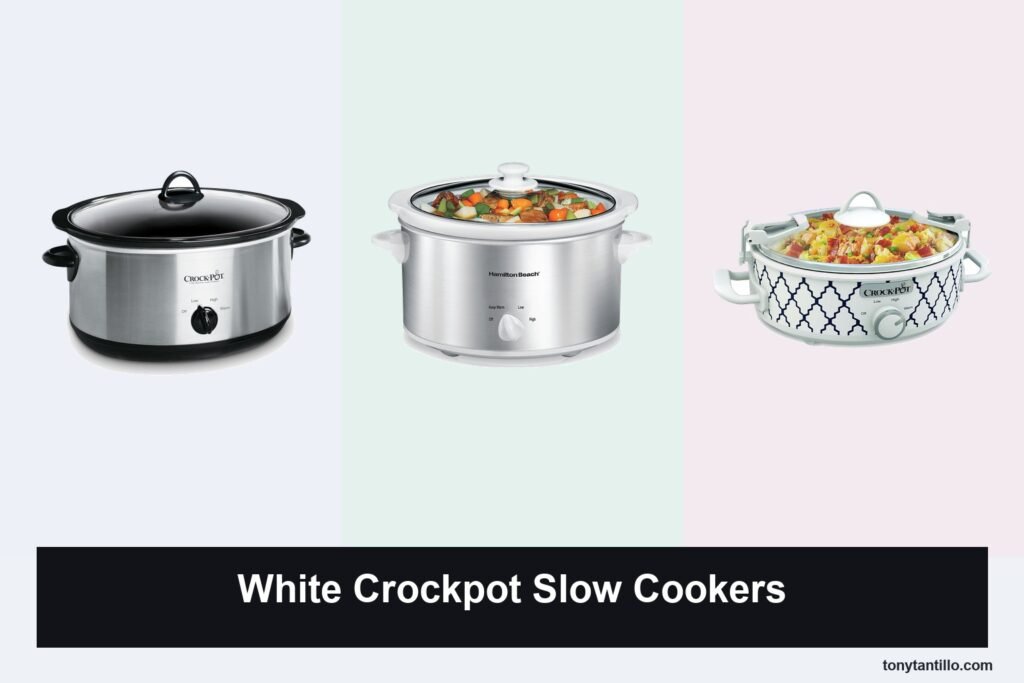
White slow cookers tend to win on two fronts at once. They can disappear into a bright kitchen without visual clutter, and they usually signal a simple, low-fuss appliance that is meant to do one job reliably. That matters in this category because the real decision is rarely whether a slow cooker can cook. It is whether it matches the meal size you actually make, the serving style you prefer, and the amount of cleanup you are willing to tolerate.
The three models here span a wide range of household needs. One is built for large roasts and family dinners, one is a mid-size everyday workhorse, and one leans compact for transport, smaller portions, and limited oven space. The best choice comes down to capacity, control simplicity, cleanup, and how often you need a warm setting or a removable stoneware insert that can do double duty.
Top White Crockpot Slow Cookers on the Market

Crock-Pot 7-Quart Manual Slow Cooker
Best for large families
- 7-quart capacity
- High, low, and warm settings
- Removable stoneware insert
- Dishwasher-safe lid and stoneware
- Fits large roasts

Hamilton Beach 4-Quart Slow Cooker
Best everyday size
- 4-quart capacity
- Low, high, and keep warm
- Glass lid included
- Dishwasher-safe crock
- Oval stoneware insert
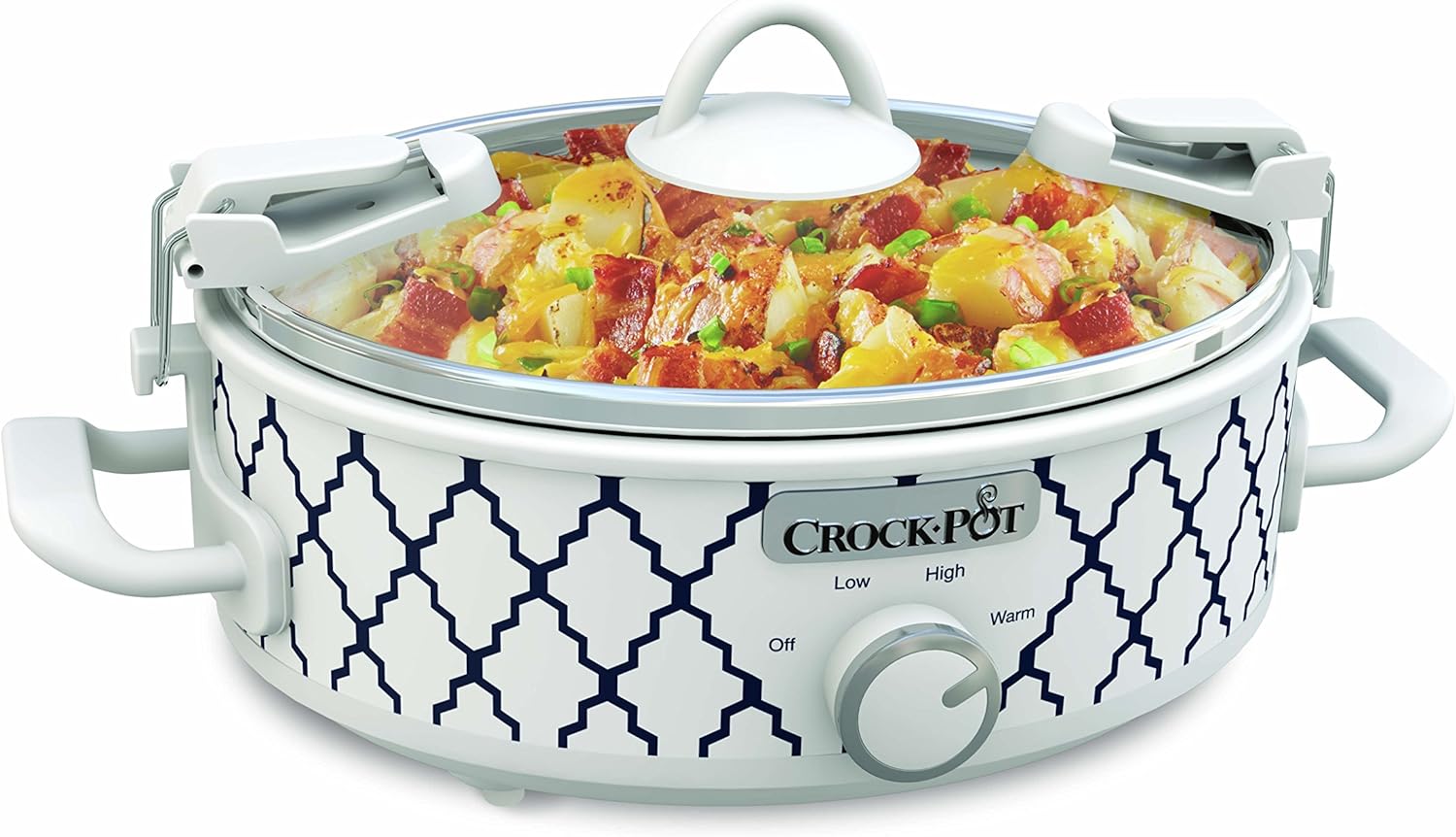
Crock-Pot 2.5-Quart Casserole Slow Cooker
Best for transport
- 2.5-quart compact size
- Cook & Carry locking lid
- Oven-safe stoneware
- High, low, and warm settings
- Dishwasher-safe parts
White Crockpot Slow Cookers Reviews
Crock-Pot 7-Quart Manual Slow Cooker
ADVANTAGES
LIMITATIONS
This is the one to consider when capacity matters more than countertop footprint. The 7-quart capacity is large enough to handle family-size meals, and the shape is sized for a roast that would overwhelm smaller cookers. That extra room changes the way you plan dinner because it can take on big batch soups, braises, and one-pot meals without forcing you to cut recipes down. The manual control approach keeps the appliance straightforward, which is useful if you want a slow cooker that simply runs on a basic schedule instead of adding complexity.
Operation is intentionally uncomplicated. The cooker runs on 210 watts at 120 volts, with three settings that cover low, high, and warm. That setup keeps the decision tree short, but it also means you are choosing a classic analog-style workflow rather than a more advanced programmable one. The removable stoneware adds flexibility after cooking because it can go into the microwave or oven up to 400°F, and the lid plus crock are dishwasher safe. Those details reduce cleanup friction, although the unit’s 16.9-inch depth means it asks for more storage and counter room than the smaller options here.
Against the two smaller cookers in this roundup, this model is the clear pick for volume and big-batch convenience. It is not the most portable and it is not the most space-conscious, but that tradeoff is exactly what makes it the strongest choice for larger households and meal preppers. The oval shape and stainless steel exterior with black accents also make it a more traditional kitchen appliance than a travel piece. For buyers who cook for a crowd and want a dependable, no-drama slow cooker, this is the most confident recommendation.
Hamilton Beach 4-Quart Slow Cooker
ADVANTAGES
LIMITATIONS
The middle-size option in this group is built for buyers who want an easier fit for weeknight cooking. Its 4-quart capacity is sized for meals serving 4 or more people, and the brand specifically notes room for a 4-pound chicken or 2-pound roast. That places it in a practical sweet spot between the big 7-quart cooker and the compact casserole-style model. It is large enough for family dinners without feeling excessive when you are cooking for a smaller household or want leftovers without committing to a giant batch.
The controls are as direct as they should be for a slow cooker. You get 4 settings through a knob-based manual interface, and the cooker runs on 195 watts at 120 volts. That combination keeps operation simple and predictable. The removable stoneware crock and glass lid are dishwasher safe, which matters because this size is likely to be used frequently. The crock can also go in the oven or microwave, so the vessel is not locked into one cooking stage and can be moved from prep to serving with less hassle.
Relative to the 7-quart Crock-Pot, this model trades away capacity for a more manageable footprint. Compared with the 2.5-quart casserole-style cooker, it gives you more room for a proper family meal and a better fit for standard one-pot recipes. That balance makes it the most versatile everyday choice in the trio. The silver-and-white finish is also less visually heavy than a darker appliance, so it can blend more easily into a mixed kitchen. If you want one slow cooker for routine use rather than specialty cooking, this is the safest middle-ground pick.
Crock-Pot 2.5-Quart Casserole Slow Cooker
ADVANTAGES
LIMITATIONS
This is the most specialized cooker in the lineup, and that is its strength. The 2.5-quart capacity is tailored to smaller meals, casseroles, side dishes, and bring-along dishes for gatherings. The casserole shape also makes serving more natural when the dish is meant to move from appliance to table. Because it is compact, it is easier to justify in kitchens where counter space is tight or where a full-size slow cooker would be too much appliance for the amount of food being made.
Its transport-friendly design is where the product earns its keep. The Cook & Carry locking lid system is built for neater travel, and the removable stoneware is oven-safe as well as dishwasher safe. That means you can cook, finish, serve, and clean with fewer vessel changes. The compact dimensions also make it easier to store than the larger models, although the small size naturally limits what you can make at once. The three settings cover high, low, and warm, so the cooking workflow stays familiar even in this more portable form.
Compared with the other two slow cookers here, this one sacrifices batch size for portability and convenience. It is not the best answer for a family that wants a week’s worth of leftovers, and it is not the best fit for a large roast. It is the better choice for potlucks, small households, and cooks who value a neat, casserole-style presentation. The white and blue finish gives it a distinct look, but the real reason to choose it is the combination of compact size and locking lid. For portable, smaller-volume slow cooking, this is the one to buy.
How to Choose White Crockpot Slow Cookers
A slow cooker looks simple, but the wrong size or control style can make it awkward to live with. The best purchase is the one that matches the meals you actually prepare, the space you have available, and how much hands-off convenience you expect from the appliance. White finishes add a clean, bright look, but the buying decision still comes down to capacity, lid design, cleanup, and whether the cooker is meant to stay home or travel.
Capacity and Meal Size
Start with the amount of food you normally cook in one session. Smaller households and side dishes usually do better with compact capacities, while family dinners and batch cooking need enough room to avoid crowding the pot. Crowding changes how evenly food cooks and can make serving more awkward. A larger bowl also gives you more flexibility with roasts, stews, and soups, but it will demand more storage space and usually more counter room.
Controls and Simplicity
Manual controls are often the right answer when you want a cooker that is easy to understand at a glance. Basic low, high, and warm settings cover most everyday needs without creating extra setup steps. More controls can be useful, but they also add decisions. If your schedule is predictable and you mainly need a dependable appliance for long simmering, simple operation is usually the better value.
Cleanup and Inserts
Removable stoneware matters because it affects both cleanup and serving. Dishwasher-safe parts reduce friction after dinner, especially if you use the cooker several times a week. Oven-safe stoneware adds another layer of flexibility because you can finish or reheat food in the same insert. That convenience is most valuable when you want fewer dirty dishes and less transfer between pans.
Portability and Lid Security
Not every slow cooker is meant to stay on the counter. If you bring dishes to gatherings or potlucks, look for a locking lid and a shape that travels well. A casserole-style form can be easier to serve from, especially for layered dishes and baked-style recipes. For transport, a secure lid is not a bonus feature. It is what separates a casual appliance from one that is practical outside the kitchen.
Footprint and Storage
The size printed on the box does not always tell the whole story. The physical dimensions and shape determine how easily the cooker fits on your counter, in a cabinet, or on a crowded buffet. Large oval models are often best when capacity is the priority, while compact designs are easier to store and carry. Before buying, think about where the cooker will live between uses. A model that fits your meals but not your cabinet will become annoying fast.
Slow Cooker Comparison Table
| Product | Best For | Capacity | Wattage | Voltage | Controls | Color |
|---|---|---|---|---|---|---|
| Crock-Pot 7-Quart Manual Slow Cooker | Best for large families | 7 quarts | 210 watts | 120 volts | Manual | Stainless Steel |
| Hamilton Beach 4-Quart Slow Cooker | Best everyday size | 4 quarts | 195 watts | 120 volts | Knob | Silver & White |
| Crock-Pot 2.5-Quart Casserole Slow Cooker | Best for transport | 2.5 quarts | 1500 watts | 220 volts | Knob | White/Blue |
How We Tested & Analyzed White Crockpot Slow Cookers
This roundup was organized around the decisions that actually matter when buying a slow cooker. Capacity, control simplicity, cleanup, and portability were treated as the primary filters because those factors determine how a cooker behaves in daily use. The analysis also weighed size and shape, since a slow cooker that fits your recipes but not your storage space is not a practical win. Where technical details were available, they were translated into real kitchen consequences rather than repeated as raw specifications.
Comparison focused on meaningful tradeoffs rather than superficial similarity. A larger vessel was evaluated against smaller, easier-to-store models. Basic manual operation was weighed against the convenience of a warm setting and travel-friendly design. Dishwasher-safe inserts and oven-safe stoneware were considered especially useful because they reduce cleanup and expand serving flexibility. When a feature mattered only in limited situations, it was treated as a niche advantage instead of a universal selling point.
Limits were handled conservatively. The article avoids claiming performance that is not directly supported by the product details, and it does not assume that one feature is automatically better for every kitchen. A buyer who cooks large roasts has a different priority than someone preparing side dishes or bringing food to a gathering. The goal is to make the tradeoffs clear so you can choose the slow cooker that fits your routine, not just the one with the longest feature list.
Frequently Asked Questions
What size slow cooker is best for everyday meals?
For most households, a mid-size cooker is the easiest to live with. It is large enough for soups, stews, and chicken dinners without taking over the kitchen. Very small models are better for side dishes or transport, while very large ones make more sense when you regularly cook for a crowd or want substantial leftovers.
Do I need a warm setting on a slow cooker?
A warm setting is useful if dinner timing is uncertain. It lets food stay ready without continuing to cook as aggressively as the main settings. That matters when family members eat at different times or when you want to keep a dish serving-friendly after the cooking cycle ends.
Why does removable stoneware matter?
Removable stoneware makes cleanup easier and often makes serving easier too. You can lift the insert out instead of scraping food from the base. If the insert is also dishwasher safe or oven safe, that adds convenience for finishing, reheating, or cleaning up after a meal.
When is a locking lid worth paying attention to?
A locking lid matters most if you transport food. It helps keep dishes neater in transit and reduces the worry of spills in the car. If the cooker will stay on your counter all the time, lid security matters less than capacity, controls, and cleanup.
Final Thoughts
White slow cookers are appealing because they look clean and practical, but the better reason to buy one is that the category still offers a lot of real-world usefulness. The right model should match your meal size, your storage space, and the kind of cooking you actually do. If you are feeding more people, size should come first. If you value speed of use and cleanup, simple controls and dishwasher-safe parts matter more than extras.
The strongest choice is the one that fits your routine without demanding workarounds. Large households should lean toward volume. Smaller kitchens and travel-minded cooks should favor compact portability. Everyday buyers usually land in the middle, where the balance between capacity and convenience is easiest to live with. Once you decide which of those priorities matters most, the right white crockpot slow cooker becomes an easy purchase rather than a guessing game.