
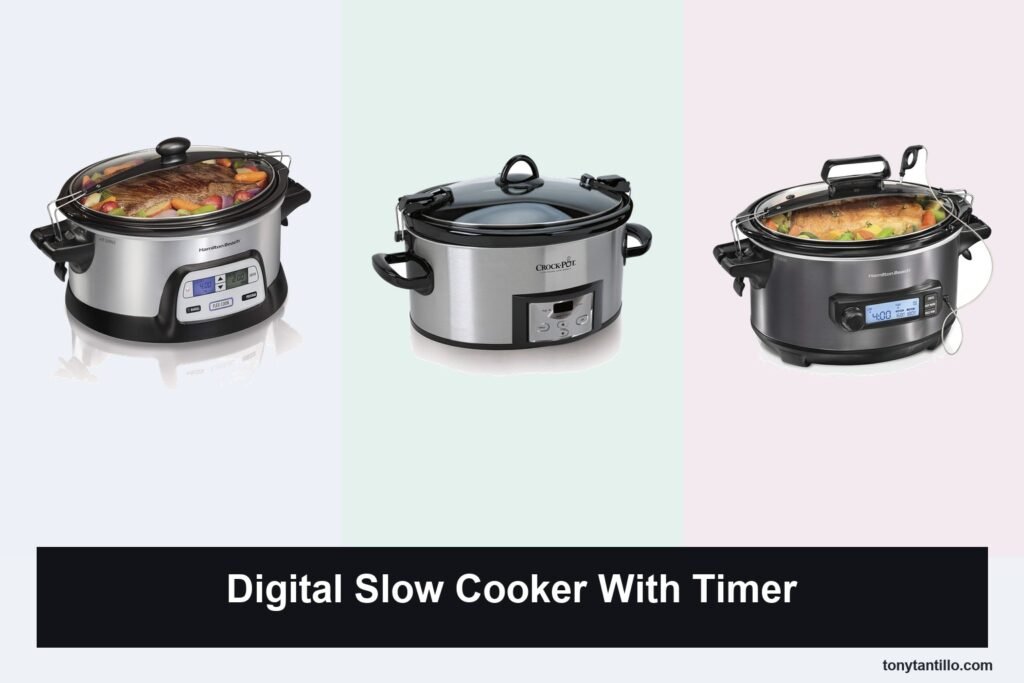
A digital slow cooker with timer earns its place by removing one of the hardest parts of slow cooking: timing the finish so dinner is ready when you are. The right model should do more than count down. It should manage heat cleanly, switch modes without fuss, and stay practical when the meal has to travel or sit for a crowd. That is why capacity, control options, cleanup, and transport features all matter as much as the timer itself.
The four cookers below cover different kinds of real-world use. Some prioritize straightforward programming and portability. Others add probe-based temperature tracking or a larger vessel for bigger gatherings. The best choice depends on whether you want the simplest set-and-forget routine, more control over doneness, or a cooker that can handle serving duty after the meal is finished.
Top Digital Slow Cooker With Timer on the Market
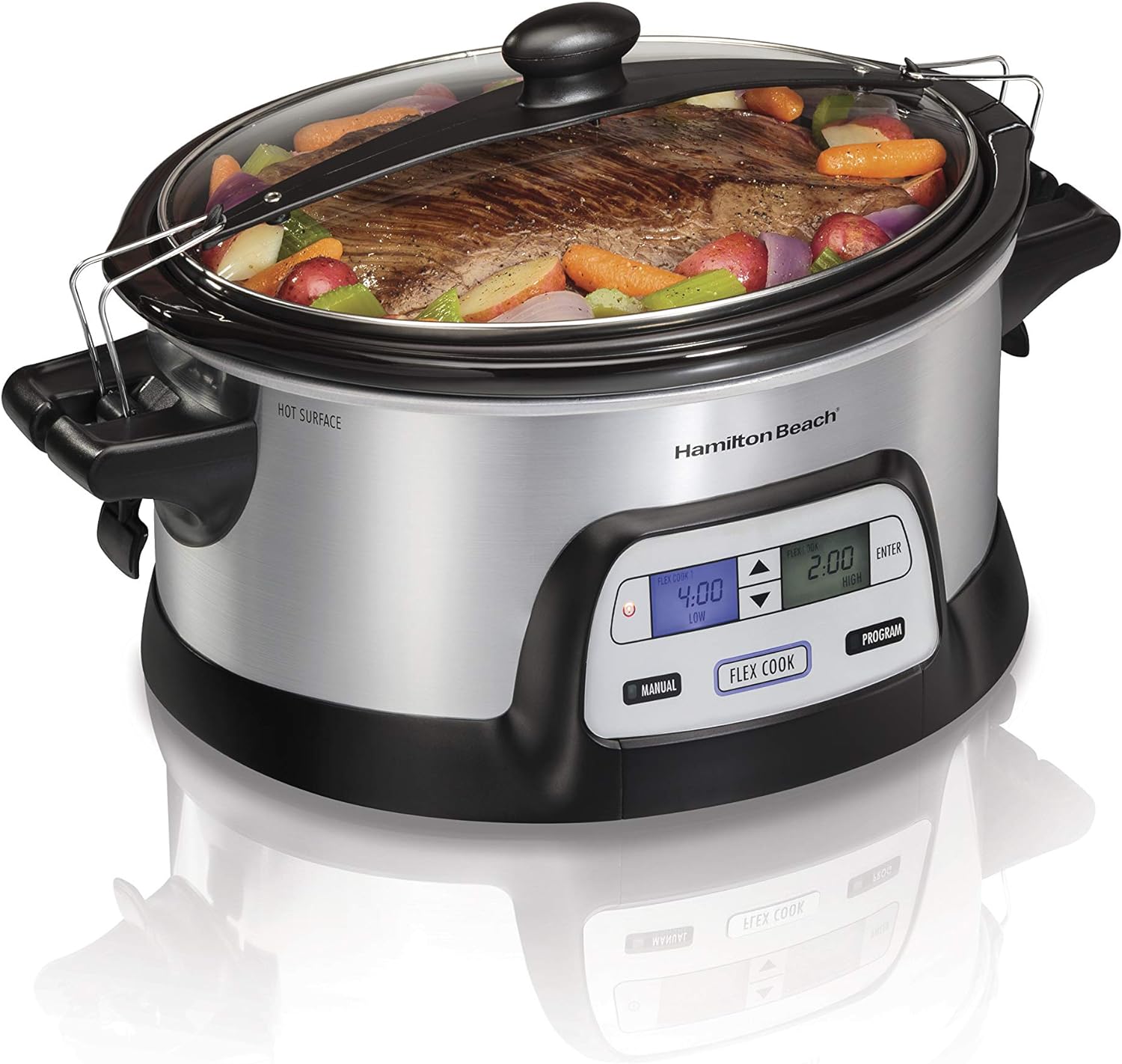
Hamilton Beach 33861 Portable Programmable Slow Cooker
Best for flexible timing
- 6-quart oval crock
- FlexCook dual timer
- Lid lock for travel
- Dishwasher-safe crock

Crock-Pot 6 Quart Cook & Carry Programmable Slow Cooker
Best for travel-ready cooking
- 6-quart capacity
- 30-minute to 20-hour timer
- Locking lid and gasket
- Oven safe to 400°F

Hamilton Beach Set & Forget 6 Quart Slow Cooker
Best for doneness control
- Integrated temperature probe
- 6-quart oval capacity
- 7 programmable settings
- Digital countdown display

Crock-Pot Large 8-Quart Programmable Slow Cooker
Best for large gatherings
- 8-quart capacity
- 20-hour digital timer
- Auto warm setting
- Removable stoneware pot
Digital Slow Cooker With Timer Reviews
Hamilton Beach 33861 Portable Programmable Slow Cooker
ADVANTAGES
LIMITATIONS
This Hamilton Beach model is the most adaptable option in the group when your schedule changes mid-cook. The 6-quart oval crock gives it enough room for a family meal, and the FlexCook system lets you split one cooking cycle into two heat-and-time stages. That matters when a recipe needs a hotter start and a gentler finish. It is also useful if you want dinner to be ready at a precise hour without staying home to adjust settings.
Operation is straightforward because the cooker can run in programmable mode or manual mode. That gives you a clean choice between timed cooking and simple high, low, or warm settings. The automatic shift to warm after cooking is the kind of safeguard that reduces overcooking risk when your timing is off. The portable design also has a practical edge. The lid lock for travel and grip handles make it better suited to potlucks and transport than many standard countertop slow cookers.
Compared with the other 6-quart options here, this one stands out for versatility rather than sheer capacity. It does not have the probe-based doneness control of the temperature-tracking model, and it is smaller than the 8-quart unit built for large groups. What it does offer is a flexible middle ground for cooks who want more scheduling control than a basic timer provides. Choose it if your biggest need is adapting the cooking cycle to the day, then taking the food on the road without a mess.
Crock-Pot 6 Quart Cook & Carry Programmable Slow Cooker
ADVANTAGES
LIMITATIONS
This Crock-Pot is aimed at buyers who want a familiar programmable slow cooker with enough range to handle long recipes. The 6-quart capacity works for a crowd without pushing into the bulk of a larger vessel, and the digital timer spans from 30 minutes to 20 hours. That range is useful because it handles quick warm-through jobs as well as all-day braises. The automatic warm function also helps keep serving pace steady once the cook cycle ends.
The secure lid system is the main operational advantage. A locking lid and rubber gasket are important if the cooker will ride in a car, because spills can happen long before you reach the table. The cooker also has oven and microwave compatibility, which adds flexibility when a recipe needs finishing, reheating, or holding in another vessel. At 240 watts, it is also the least power-hungry of the group, which may matter to buyers who value efficiency alongside convenience.
Against the other contenders, this model does not have the temperature probe that gives one Hamilton Beach cooker tighter doneness control. It also lacks the larger 8-quart capacity that favors holiday-scale batches. What it does better than most is combine broad timer range, transport-friendly sealing, and lower wattage in a package that remains easy to understand. It is the right pick for anyone who routinely carries food to events and wants a timer-driven slow cooker that keeps the trip simple.
Hamilton Beach Set & Forget 6 Quart Slow Cooker
ADVANTAGES
LIMITATIONS
This Hamilton Beach cooker is the strongest choice for buyers who care about precision, not just elapsed time. The integrated temperature probe tracks internal food temperature, which changes how you use a slow cooker for meat. Instead of guessing whether beef, pork, or poultry is finished, you can program around a target temperature and let the cooker react to the food itself. The temperature probe is the feature that separates it from the more basic timer-driven models here.
That extra control comes with real practical value in the kitchen. The digital display can show remaining cook time and toggle to the current internal temperature when the probe is in use, so you always know what the food is doing. The 7 programmable settings also give it more operating modes than the simpler 3-setting cookers in this roundup. The hold-temperature function opens up extra uses beyond standard slow cooking, including sous vide, yogurt, simmering, braising, and fondue.
It is the best fit for a buyer who wants more than a standard set-and-forget timer. The tradeoff is that the feature set is more specialized, so someone who just wants a basic programmable vessel may not need all of its control options. It is still a 6-quart slow cooker, so it will not outsize the larger Crock-Pot holiday model. Choose this one when accuracy matters more than simplicity and when you want one cooker that can do far more than basic low-and-warm operation.
Crock-Pot Large 8-Quart Programmable Slow Cooker
ADVANTAGES
LIMITATIONS
This is the obvious pick when quantity matters more than portability. The 8-quart capacity is the largest in the group, and that extra volume makes a real difference for holiday sides, big roasts, and dishes meant to feed a crowd. The digital timer runs up to 20 hours, so long recipes are easy to manage without hovering over the cooker. The auto warm setting adds a useful final step, since the food can stay service-ready after the initial cook cycle ends.
The larger body changes the setup equation. At 15.4 inches wide and 15.3 inches high, it is less compact than the 6-quart cookers, so counter space and storage matter more. That is the tradeoff for being able to serve over 10 people. Cleanup stays manageable because the lid and stoneware pot are removable and dishwasher-safe. The black stainless finish also gives it a more polished look, which is useful if the cooker will stay on the table instead of hiding on the counter.
Relative to the other three, this one is the least portable and the least specialized in control features, but it is the strongest serving vessel. It does not add a temperature probe or a travel-first lid system. Instead, it focuses on size, a long digital timer, and easy warm holding. That makes it the right recommendation for hosts who care most about batch size and after-cook serving continuity. For large-family dinners and entertaining, it is the most straightforward buy in the roundup.
How to Choose a Digital Slow Cooker with Timer
A good digital slow cooker with timer should match the way you actually cook, not just the way you imagine dinner on a quiet evening. Some buyers need simple countdown control and a reliable warm setting. Others need a lid that can travel safely, a vessel big enough for guests, or a more advanced way to track doneness. The right choice depends on the balance between capacity, controls, cleanup, and how much intervention you want after the pot starts cooking.
Capacity and Batch Size
Capacity is the first filter because it determines whether the cooker suits a weeknight meal or a holiday spread. A 6-quart model is usually the safer middle ground for families, roasts, and casseroles. An 8-quart model is better when the goal is serving more people at once, especially if you want leftovers. Choosing too small a vessel is more limiting than choosing a slightly larger one, because you lose flexibility for bulky cuts and party portions.
Timer Range and Workflow
Timer range matters because not every recipe follows the same rhythm. A broader countdown window gives you more room for overnight cooking, long braises, or a meal that needs to start earlier than expected. Shorter timers can still work well for everyday recipes, but they are less forgiving when dinner plans change. Look for a cooker that can start cooking without forcing you to stay near the kitchen, then shift cleanly into warm mode when time is up.
Control Style
The best control style depends on how hands-on you want to be. Basic high, low, and warm settings are enough for many households, especially when the recipe is already familiar. Programmable models are more convenient because they remove guesswork from the cook cycle. More advanced controls, such as multi-stage programming or temperature probes, are worth paying for only if you will actually use that extra precision. Otherwise, simpler controls are often easier to live with every day.
Travel and Sealing
If the cooker ever leaves your kitchen, sealing becomes a major decision point. A locking lid and a good gasket reduce spill risk during car trips and make the slow cooker much more useful for potlucks, tailgates, and family gatherings. Even if you do not travel often, a secure lid can still help when the cooker is full and crowded on a table. Portability should also include practical details like handles and weight, since a heavy vessel is less convenient to carry even if it seals well.
Cleanup and Materials
Cleanup affects whether a slow cooker feels convenient after the meal or like another chore. Removable stoneware and dishwasher-safe components save time, especially after thick sauces or long braises. Material matters too because it changes both appearance and upkeep. Stoneware interiors are common for even heating and easy serving, while stainless exteriors can be easier to wipe clean and may look better if the cooker stays on display. Choose the combination that fits your routine rather than assuming every finish behaves the same.
Extra Cooking Functions
Some digital slow cookers do more than count down and hold warm. Probe-based temperature tracking, hold-temperature modes, and broader function menus can extend the cooker into recipes like sous vide, yogurt, or fondue. Those extras are useful if you want one appliance to cover several techniques. They are less valuable if you mostly make chili, pulled meat, or stews. The right question is whether the extra flexibility will change what you cook, not whether it sounds impressive on a spec sheet.
Slow Cooker Comparison Table
| Product | Best For | Capacity | Wattage | Controls | Settings | Warranty |
|---|---|---|---|---|---|---|
| Hamilton Beach 33861 Portable Programmable Slow Cooker | Best for flexible timing | 6 quarts | 280 watts | Touch | 3 | One Year Warranty |
| Crock-Pot 6 Quart Cook & Carry Programmable Slow Cooker | Best for travel-ready cooking | 6 quarts | 240 watts | Touch | 3 | 1yr |
| Hamilton Beach Set & Forget 6 Quart Slow Cooker | Best for doneness control | 6 quarts | 290 watts | Touch | 7 | One year warranty |
| Crock-Pot Large 8-Quart Programmable Slow Cooker | Best for large gatherings | 8 quarts | 1500 watts | Touch | 3 | Warranty |
How We Tested & Analyzed Digital Slow Cooker with Timer
This roundup prioritized category-level features that directly change ownership and cooking behavior. Timer range, heat control, capacity, travel security, cleanup, and material construction were weighted more heavily than cosmetic details because those are the things that determine whether a cooker is practical in daily use. Where a model added a probe, a larger vessel, or a locking lid, that mattered only insofar as it changed workflow, transport, or doneness control. The goal was to compare how each cooker behaves in a real kitchen, not to reward the longest feature list.
To keep the analysis grounded, each product was evaluated by how clearly its verified specifications support a distinct buying use case. A model that is simple and portable competes differently from one that prioritizes precision or party-sized volume. That meant comparing the consequences of timer length, wattage, control layout, and vessel size rather than treating them as isolated facts. The same approach also keeps tradeoffs visible. A more advanced cooker is not automatically better if the buyer only needs a dependable timer and a warm setting.
The limits of the category were also part of the analysis. A slow cooker can reduce active attention, but it still depends on sensible portion sizing, proper setup, and the right expectations for travel and cleanup. Some features are genuinely specialized, so they only matter for certain buyers. The recommendations therefore focus on matching feature sets to likely use patterns. That produces a more useful result than ranking every model against one abstract standard of performance.
Frequently Asked Questions
What size slow cooker should most families buy?
A 6-quart slow cooker is the most versatile starting point for many households because it handles family dinners without becoming awkwardly large. An 8-quart model makes more sense when you regularly cook for gatherings, want substantial leftovers, or prepare larger cuts of meat. The right answer is the one that matches your portion size most weeks, not just your biggest annual meal.
Is a digital timer better than manual controls?
A digital timer is better when you want the cooker to manage time automatically and shift into warm mode without attention. Manual controls are still useful if you prefer a simpler interface or cook by feel. The deciding factor is how much predictability you want. If you need a true set-and-forget routine, the timer is a meaningful upgrade.
Do locking lids really matter?
They matter most when you carry food to another location. A locking lid with a good seal reduces spill risk and makes transport less stressful. Even if you rarely travel, it can still be useful for moving a full cooker around the kitchen or table. If the cooker will stay parked at home, the feature is helpful but not essential.
When is a temperature probe worth paying for?
A temperature probe is worth paying for if you cook meat often and want more confidence about doneness. It changes the cooker from a time-based tool into a temperature-aware one, which is especially useful for poultry and roasts. If you mainly make soups, chili, or stews, a standard programmable timer is usually enough and easier to live with.
Final Thoughts
A digital slow cooker with timer is most useful when it removes uncertainty from mealtime. The best model is not always the one with the most features. It is the one whose capacity, control style, and cleanup fit your real routine. For some buyers, that means a portable 6-quart cooker with a sealed lid. For others, it means a larger vessel for guests or a more advanced system that tracks doneness instead of just counting down time.
Choose the cooker that matches the way you cook most often, then let the extras work in your favor rather than forcing you to learn a new routine. If you want flexible timing, travel security, or a larger serving vessel, this category has a clear option for each need. Once you know whether your priority is simplicity, precision, or volume, the right slow cooker becomes much easier to spot.