
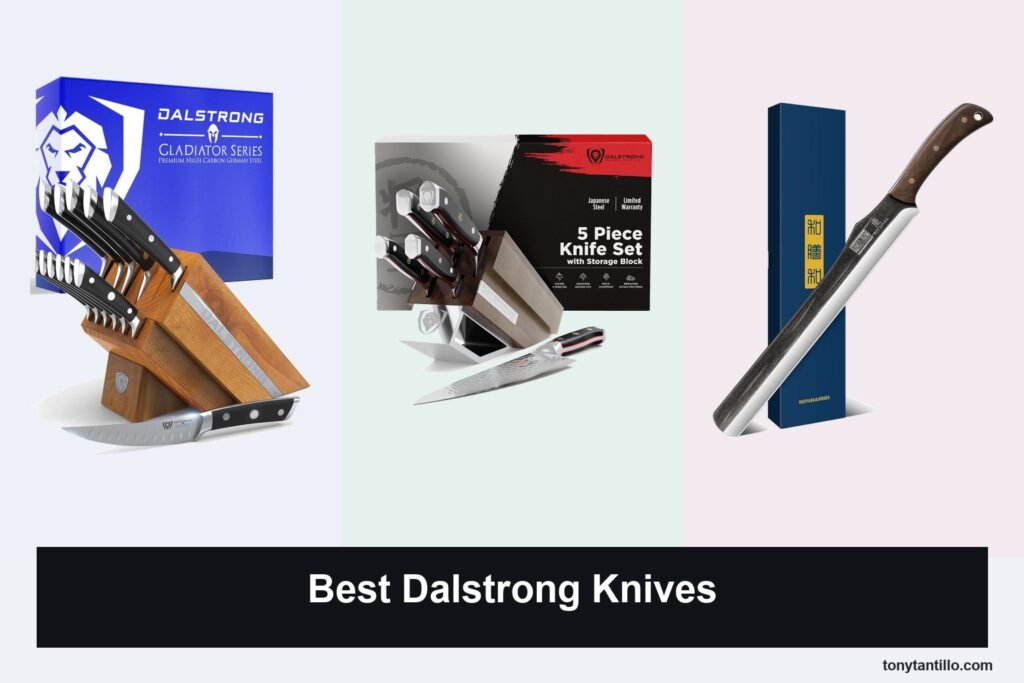
Dalstrong has built a following by pushing kitchen knives toward two different goals at once: broad utility for everyday cooking and specialized performance for cooks who want a sharper, more deliberate cutting experience. That creates a real decision point for buyers. Some sets are meant to replace a drawer full of mismatched pieces. Others focus on precision and edge geometry. The right choice depends on how you cook, how much counter space you have, and whether you want a full block set or a single task-specific knife.
This roundup focuses on the clearest differences among three Dalstrong options. One is a large 12-piece block set with German styling and a broad spread of kitchen roles. One is a smaller Japanese-style block set built around high precision and a compact core lineup. The third is a long carving knife aimed at brisket, roasts, and clean slicing work. Together they cover the main buyer profiles in this category, so the best pick becomes less about brand loyalty and more about matching the knife to the way you actually prepare food.
Top Dalstrong Knives on the Market

Dalstrong 12-Piece German Knife Block Set
Best Full Kitchen Set
- 12-piece kitchen lineup
- High-carbon steel blades
- Manchurian Ash block
- NSF certified

Dalstrong 5-Piece Japanese Knife Block Set
Best Precision Set
- Five essential knives
- 66-layer Damascus pattern
- AUS-10V steel core
- 8–12° edge angle

HOSHANHO 12-Inch Brisket Carving Knife
Best Slicing Knife
- 12-inch slicing blade
- 15° blade angle
- 58HRC hardness
- Walnut handle
Dalstrong Knives Reviews
Dalstrong 12-Piece German Knife Block Set
ADVANTAGES
LIMITATIONS
This is the broadest option in the group, and that matters if you want one purchase to cover most of the kitchen. The set includes an 8-inch chef knife, a 6-inch chef knife, a 7-inch santoku, a 7-inch nakiri, a 6-inch boning knife, a fillet knife, six 5-inch steak knives, a honing rod, and the block. That mix covers daily prep, fish, meat trimming, vegetable work, and table use without sending you back to a drawer full of replacements. The high-carbon steel blade material gives the set a more serious feel than a generic starter block, while the 16–18° per side edge geometry points to a fairly versatile cutting profile rather than an ultrafine specialty edge.
The size and construction choices are what make this set feel built for regular kitchen life instead of display only. The knives are forged, full-tang, and paired with ABS handles, so the set is aiming for balance and durability rather than ultra-light finesse. The handmade Manchurian Ash block is oil-finished and designed to stay on the counter, which means you need the space and should expect a permanent home for it. At 14.6 pounds and nearly 20 inches long, this is not a casual drawer set. The upside is that the organization is immediate, and every blade has a defined place, which reduces the usual clutter that comes with mixed knife collections.
Against the smaller Japanese set, this is the more practical choice for cooks who want coverage first and specialization second. The broad blade mix makes it easier to move from meal prep to serving without changing systems, and the six steak knives add clear table value that the other sets do not match. It is also the most complete fit for families or hosts who want a single knife block to handle everything from chopped herbs to carved meat. The tradeoff is that it is less focused on ultra-thin precision cutting than the Japanese option. For most home kitchens, though, that broader usefulness is exactly the point, and this is the Dalstrong set I would choose for all-around utility.
Dalstrong 5-Piece Japanese Knife Block Set
ADVANTAGES
LIMITATIONS
This set is for cooks who care more about cutting feel and edge refinement than about sheer piece count. The five included knives cover the main prep roles with an 8-inch chef, 7-inch santoku, 6-inch utility, 8-inch bread knife, and 3.75-inch paring knife. That is a deliberate lineup, not an overloaded one, and it keeps the focus on blades you are likely to use constantly. The 66-layer Damascus construction gives the set a more refined presentation, while the 8–12° edge is much sharper and more specialized than the broader edge geometry of the German-style set. For cooks who want cleaner prep with less resistance, that edge angle is one of the most important details here.
The technical package makes sense only if you appreciate the tradeoffs that come with high-performance knives. The blades use AUS-10V Japanese super steel and are nitrogen-cooled, vacuum heat-treated, and corrosion resistant. That combination points to a knife set designed for edge retention and sharper slicing behavior, not a casual utility block built to be treated rough. The handles are Ultra-G10 military-grade fiberglass laminate, which suggests a more performance-driven grip than the ABS handles on the larger set. The set also includes PerfectFit sheaths and an acacia block, so storage is still organized even though the overall footprint stays smaller. At 1.8 pounds, it is far easier to place and move than the heavier full block set.
Compared with the 12-piece German set, this is the sharper specialist. It gives up quantity, steak knives, and broad table utility, but it wins on precision and a more focused five-knife lineup. That makes it a better fit for cooks who already know which blades they use most and want each one to perform at a higher level. It is also the stronger choice if you like Japanese-style prep, thin slicing, or a more deliberate feel on the board. The price is higher, so value depends on whether you will use the performance. If you will, this is the more refined recommendation and the best Dalstrong option for precision-focused home cooks.
HOSHANHO 12-Inch Brisket Carving Knife
ADVANTAGES
LIMITATIONS
This knife occupies a very different spot in the lineup because it solves one job extremely well. The 12-inch blade is built for brisket, roasts, turkey, grilled meats, and other large cuts where long, smooth strokes matter more than multi-knife convenience. The 12-inch blade length is the main reason it stands apart, since long contact across the cut helps keep slices cleaner and more uniform. The 15° blade angle is tuned to reduce cutting resistance, which is exactly what you want when you are trying to preserve the structure of smoked meat or avoid tearing delicate slices. At 8.8 ounces, it is also light enough to stay controllable through long carving sessions.
The material and handle details show that this is a purpose-built tool rather than a general chef knife wearing a carving label. It uses high carbon stainless steel with a 58HRC hardness rating, and it is forged rather than stamped. That combination supports sharpness and edge retention while still keeping the knife in a practical range for regular home use. The full tang and riveted walnut handle add stability, which matters when you are working through dense barbecue bark or a large holiday roast. Because the blade is long and the profile is specialized, this knife works best when the cutting board has enough space to support full strokes. It is less about chopping motion and more about clean, uninterrupted slicing.
Compared with both Dalstrong block sets, this knife is the least versatile and the most focused. That is not a weakness if your priority is barbecue, holiday carving, or large-format proteins. In those situations, a dedicated slicer can outperform a multipurpose chef knife because the geometry is simply more suited to the cut. It will not replace a full kitchen set, and it does not try to. What it does is give serious attention to long slicing work at a much lower price than either block set. For anyone who already owns a capable general-purpose knife collection and wants a dedicated carver, this is the easiest recommendation in the group.
How to Choose Dalstrong Knives
The best Dalstrong knife is the one that matches how you cook, not the one with the most dramatic steel story. Start with the job you need it to do most often. A full block set is about coverage and convenience. A precision-focused Japanese set is about control and sharper slicing. A long carving knife is about one specific task done well. Once you decide which of those problems you are solving, the rest of the decision becomes much easier.
Set Size and Coverage
The first decision is whether you want a complete knife system or a single-purpose tool. Larger sets are useful when you cook across many categories and want the same balance and feel every time you reach for a blade. Smaller sets make more sense if you already own a few workhorses and only want to upgrade the core pieces. More pieces are not automatically better. They are only better if you will actually use them, store them properly, and keep them sharpened.
Blade Geometry
Blade angle changes the way a knife feels on the board. A narrower edge angle usually slices more cleanly and with less resistance, which is why precision-oriented knives appeal to cooks who value thin cuts and refined control. A broader angle is often less delicate but can feel more forgiving in everyday kitchen work. If you cook a lot of vegetables, fish, or paper-thin slices, edge geometry deserves real attention. If you want a tougher all-purpose blade, a slightly broader profile may be the safer choice.
Steel and Hardness
Steel type and hardness affect edge retention, sharpening behavior, and how carefully you need to treat the knife. High-carbon and super-steel options can stay sharp longer, but they also tend to reward proper care. Harder blades may hold a fine edge very well, yet they are not the best match for rough technique or careless storage. Softer or more general-purpose builds may be easier to live with, especially in busy home kitchens. The right balance depends on whether you want maximum sharpness or easier maintenance.
Handle and Balance
A knife can have an excellent blade and still feel wrong if the handle shape, material, or weight distribution does not suit your hand. Full-tang construction usually improves stability and helps the knife feel more planted during longer prep sessions. Heavier sets can feel reassuring on the counter, while lighter knives often feel quicker and less tiring during repeated slicing. Handle material matters too, especially if you care about grip texture and long-term durability. The best choice is the one that feels secure without forcing your wrist into an awkward angle.
Storage and Space
Storage is easy to overlook until the knives arrive. A block set needs permanent counter space and enough room for safe removal and return. That can be a benefit if you want a defined home for every blade, but it is a drawback in smaller kitchens where work surface is already limited. Sheaths can reduce storage friction, while a single carving knife may be easiest of all to tuck into an existing drawer system. Before buying, make sure the storage format fits your kitchen rather than assuming it will fit somewhere later.
Use Case Priority
The most important question is how often you will use the specialty features you are paying for. If you host often, a block set with steak knives and broad prep coverage can save money and simplify the kitchen. If you cook technically and care about fine slicing, a smaller precision set can be the smarter long-term purchase. If your biggest meals revolve around barbecue, roasts, or holiday carving, a dedicated slicer is more sensible than an oversized set. Buying well means matching the knife to the work, not the brand to the shelf.
Knife Set Comparison Table
| Product | Best For | Blade Material | Edge | Handle | Weight | Length |
|---|---|---|---|---|---|---|
| Dalstrong 12-Piece German Knife Block Set | Best Full Kitchen Set | High Carbon Steel | Hand-polished 16–18° per side | Acrylonitrile Butadiene Styrene | 14.6 pounds | Not Specified |
| Dalstrong 5-Piece Japanese Knife Block Set | Best Precision Set | Alloy Steel | Honbazuke mirror-polished 8–12° per side | Ultra-G10 military-grade fiberglass laminate | 1.8 pounds | 8 inches |
| HOSHANHO 12-Inch Brisket Carving Knife | Best Slicing Knife | High Carbon Stainless Steel | Plain | Walnut | 8.8 ounces | 12 inches |
How We Tested & Analyzed Dalstrong Knives
This roundup was built around category-level differences that matter in daily use: blade count, intended task range, blade geometry, steel type, handle construction, storage format, and weight. Those factors tell a buyer much more than marketing language does because they affect how the knife will feel in the hand, how much space it will occupy, and how broadly it can replace other tools in the kitchen. The goal was to compare useful decision points rather than simply rank products by price or piece count.
Each product was evaluated as a distinct buying proposition. A full block set was judged on coverage and organization. A smaller premium set was judged on precision and the balance between specialization and practicality. A carving knife was judged on how well its length, weight, and edge profile suit a narrow slicing job. That approach matters because a product that looks less versatile on paper can still be the best purchase if it solves the reader’s main problem more efficiently than a larger option.
Limitations also matter in this category. Knife sets can look similar while differing dramatically in edge angle, storage footprint, and maintenance expectations. A careful buyer needs to understand those tradeoffs before choosing. This analysis therefore emphasizes consequences, not just specifications. It favors clarity about who benefits from each design and what compromises come with it, so the final recommendation reflects real-world kitchen priorities rather than abstract feature lists.
Frequently Asked Questions
Should I buy a knife set or a single knife?
Buy a set when you need coverage across many tasks and want a matched group of blades and storage. Buy a single knife when you already have a working collection and need a tool for one specific job. A set is about convenience and consistency. A single knife is about targeted performance and lower cost for the right task.
What makes blade angle important?
Blade angle affects how easily a knife enters food and how refined the cut feels. Narrower angles usually cut with less resistance and suit precision work. Slightly broader angles can feel more forgiving for daily kitchen use. The best angle depends on whether you care more about delicate slicing or general-purpose durability.
Does heavier always mean better?
No. Heavier knives can feel stable and authoritative, especially when cutting dense ingredients, but they can also fatigue your hand if you do a lot of repeated prep. Lighter knives often feel quicker and easier to control for extended slicing. The right weight is the one that stays comfortable through the kind of cooking you actually do.
How much should storage influence the decision?
Quite a lot. A block set needs visible counter space and a permanent home. That is fine in a larger kitchen, but it can be awkward in a tight one. If your counters are crowded, a smaller set or a single knife may be the smarter choice. Storage that fits your space is part of the value, not an afterthought.
Final Thoughts
The best choice here comes down to how wide you want your knife coverage to be. A full block set is the most practical answer for households that cook often and want a ready-to-use system. A smaller Japanese set is the stronger pick for cooks who value sharper slicing and more refined control. A dedicated carving knife wins when the real need is clean, long cuts through brisket, roasts, and other large proteins.
Choose the knife that solves your most common kitchen problem first. That simple filter will keep you from overbuying a set with features you will not use or underbuying a specialty blade that cannot keep up with your cooking style. In a category this dependent on fit, the best Dalstrong knife is the one that feels obvious once you map it to your actual meals.