
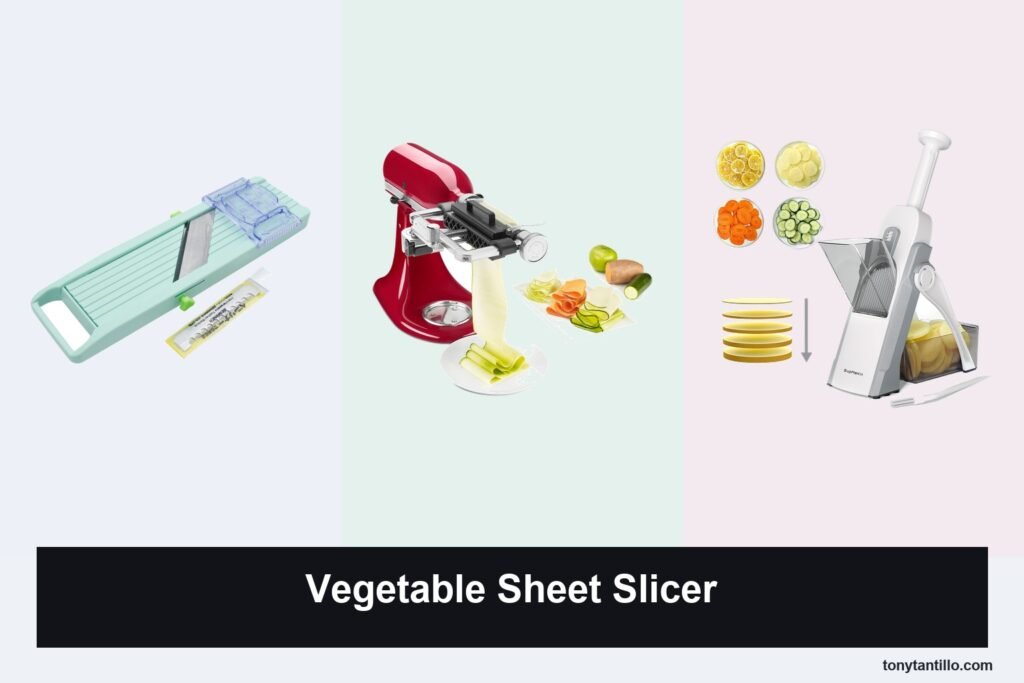
A good vegetable sheet slicer solves a very specific problem in the kitchen. It has to turn firm produce into even sheets without turning prep into a fight, and it has to do that safely enough that you will actually use it for weeknight cooking. The best choices in this category also differ sharply in how they work. Some are manual, some attach to a stand mixer, and some prioritize compact control over sheer speed. That means the right pick depends less on the idea of slicing vegetables and more on how you cook, how much prep you do, and how comfortable you are with cleanup and storage.
The five recommendations below cover that spread from a traditional handheld mandoline to a powered mixer attachment and a specialty crinkle cutter. I focused on blade adjustability, stability, material quality, cleanup demands, and the kinds of produce each tool handles best. Where the evidence supports it, I also looked at practical constraints such as hand-wash-only care, dishwasher-safe parts, included accessories, and whether the cutter is better suited to thin garnish work or bulk vegetable prep. That mix matters, because vegetable sheet tools can look similar on paper while performing very differently in real use.
Top Vegetable Sheet Slicer on the Market

Benriner Japanese Vegetable Slicer
Best Precision Slicer
- Adjustable thickness control
- Stainless steel blade
- Hand-wash only care
- Compact 8-inch body

KitchenAid KSMSCA Sheet Cutter
Best Stand Mixer Add-On
- Mixer-powered operation
- Thin and thick blades
- Metal construction
- Storage case included

SupMaKin Safe Adjustable Mandoline
Best Safety-Focused Design
- Built-in blade design
- 0.1 to 8 mm range
- Foldable compact body
- 2 year warranty

OXO Good Grips Handheld Mandoline
Best Handheld Option
- 1 mm to 4 mm settings
- Non-slip handle and foot
- Clear viewing window
- Dishwasher safe

Tellshun Crinkle Cutter
Best Budget Specialty Tool
- Wavy crinkle blade
- 430 stainless steel
- Compact 4.25-inch size
- Lightweight manual tool
Vegetable Sheet Slicer Reviews
Benriner Japanese Vegetable Slicer
ADVANTAGES
LIMITATIONS
The Benriner Japanese Vegetable Slicer, Old Version is the most straightforward choice here for buyers who want a compact manual tool with precise control. Its adjustable blade covers slices from fine to medium, and the coarse replaceable blades extend the range to three different sizes. That flexibility matters when the same slicer needs to handle delicate garnishes one day and thicker vegetable sheets the next. The stainless steel blade gives the tool the right edge retention for repeated prep, while the ABA plastic body keeps the unit light at 290 g. For a kitchen that values speed without moving to a powered attachment, that balance is hard to ignore.
The compact 8″ x 1″ x 1″ form factor keeps it easy to store, but it also means this is a tool best used with a stable prep surface and a little attention to technique. Because it is manual and hand wash only, it rewards cooks who are comfortable with a simple, low-tech workflow rather than those who want a set-and-forget machine. The 2.5 centimeter blade length is enough for efficient slicing, but the narrow frame makes the cut path feel more like a precision tool than a bulk processor. That is exactly why it works so well for controlled vegetable sheets.
Compared with the other options here, this model stands out for its directness. It does not rely on a mixer, it does not add a large foot print, and it does not ask you to manage extra accessories. The tradeoff is that you supply the force and the consistency. That makes it best for buyers who want a dependable slicer for vegetables and value a smaller, simpler setup over maximum automation. If you want a clean manual mandoline with a serious reputation and clear thickness control, this is the strongest all-around precision pick in the group.
KitchenAid KSMSCA Sheet Cutter
ADVANTAGES
LIMITATIONS
The KitchenAid KSMSCA Vegetable Sheet Cutter for Kitchenaid Stand MIxers is built for buyers who already rely on a compatible stand mixer and want to turn that motor into a sheet-cutting station. It connects to the mixer power hub, so the workload shifts away from your hand and into the appliance. That setup suits thicker prep sessions better than a handheld cutter, especially when you want consistent sheets of zucchini, cucumbers, or apples. The included thin blade and thick blade let you choose between more delicate sheets and heartier cuts, which makes the attachment much more versatile than a single-format specialty tool.
The premium metal construction is an important part of the appeal because it provides the rigidity this style of attachment needs. At 10.8″ x 7.9″ x 3″ and 2.5 pounds, it is not a small add-on, so the storage case matters as much as the cutter itself. The case keeps the blades, adapter, skewer, and food holder organized, which reduces the usual clutter that comes with mixer accessories. Cleanup is also practical for a powered attachment because the blades, adapter, skewer, and food holder are top-rack dishwasher safe, while the body can be wiped clean. That division is convenient, but it also shows that this is a larger system, not a casual countertop gadget.
Against the manual slicers in this group, the decisive advantage is effort reduction. You gain stability from the mixer and avoid the repetitive hand motion that a handheld mandoline demands. The tradeoff is compatibility, since this only makes sense if you already own the right KitchenAid stand mixer. For that buyer, it is the most capable option for creating vegetable sheets with less physical strain. If your goal is to expand a mixer you already have, this attachment is the clear recommendation.
SupMaKin Safe Adjustable Mandoline
ADVANTAGES
LIMITATIONS
The SupMaKin Safe Mandoline Slicer for Kitchen,Adjustable Potato Slicer 1-8 mm is aimed at buyers who want a safer, faster manual slicer with a wide thickness range. The built-in blade design removes the need to touch blades during setup, which is the main reason this style is appealing to cautious home cooks. Its 0.1 to 8 mm adjustment range also gives it more flexibility than many basic mandolines, so it can move from paper-thin slices to thicker cuts without changing tools. The 3-inch port is sized for common prep ingredients like potatoes, carrots, cucumbers, garlic, and similar produce, which makes it useful for routine cooking as well as larger prep jobs.
In day-to-day use, the non-slip base and ergonomic design matter as much as the sharp stainless steel blades. They help keep the slicer planted while you push food through the handle, and that stability is important when you are working with harder vegetables. The foldable build is another practical advantage because the unit measures 5″ x 6″ x 13″ and weighs 1.5 pounds, so it is compact enough for a modest kitchen but still substantial enough to feel purposeful. Cleanup is also easier than many manual slicers because it is dishwasher safe, and the included feed port, cover container, and brush suggest a design that expects regular use rather than occasional novelty.
Compared with the Benriner, this model puts more emphasis on safety and range. Compared with the OXO, it offers a broader thickness span and a more enclosed slicing approach. Those traits make it especially attractive for buyers who want a manual slicer that feels less exposed during use and more versatile for batch prep. The main limitation is size and complexity relative to the simplest handheld tools, but that is the price of gaining more control and a safer workflow. For a family kitchen or prep-heavy routine, this is the most practical safety-first pick.
OXO Good Grips Handheld Mandoline
ADVANTAGES
LIMITATIONS
The OXO Good Grips Handheld Mandoline Slicer with Non-Slip Handle for Kitchen is the most approachable choice for buyers who want something simple, compact, and easy to position anywhere on the counter. Its three thickness settings, 1 mm, 2.5 mm, and 4 mm, cover the most common slicing needs without forcing you to manage a more elaborate mechanism. The large non-slip handle and stable foot are the features that make this style work, because they let you keep control while slicing potatoes, cabbage, onions, cheese, or fruit. For quick meals or small batches, that combination is efficient and easy to understand.
The slim 3.75″ x 0.5″ x 11.5″ body makes storage painless, and the 0.16 kg weight keeps it featherlight in the hand. That portability is useful when you want to slice directly onto a plate, on a cutting board, or over a bowl instead of moving ingredients around afterward. The clear window is a small but meaningful detail because it helps you watch volume as it builds, which reduces over-slicing when you only need a small amount. Dishwasher-safe care also lowers the friction of owning it, since there is no large body or attachment system to disassemble.
Relative to the more adjustable manual slicers in this set, the OXO trades some range for a cleaner, easier everyday routine. Relative to the mixer attachment, it is obviously more manual, but it is also far cheaper in effort and much less demanding in kitchen space. That makes it ideal for cooks who want a dependable handheld tool for moderate prep rather than a full vegetable-processing system. If your priority is convenience, storage ease, and controlled slicing for smaller jobs, this is the safest recommendation.
Tellshun Crinkle Cutter
ADVANTAGES
LIMITATIONS
The Crinkle Cutter Stainless Steel Potato Veggies Wavy Chop French Fry Slicer is a niche tool, but it earns a place here for buyers who want a low-cost way to add texture to vegetables and fruit. Its stainless steel cutting edge produces the familiar wavy profile that changes the look of potatoes, onions, carrots, apples, and tomatoes. That matters when the visual finish is as important as the cut itself, such as for tray sides, snack boards, or homemade fries. At this price point, the appeal is not versatility in the mandoline sense. It is a simple, dedicated cutter that gives food a distinct finish quickly.
The compact 4.25″ x 3.7″ x 0.59″ body and 2.95-inch blade length make it easy to store and easy to pick up for quick jobs. The ABS handle is meant to improve grip, and the lightweight build keeps it from feeling cumbersome during repeated cuts. Because it is manual, it does not replace a sheet slicer for thin, even vegetable sheets, but it does offer a clean, low-fuss option when straight slices are not the goal. Care instructions indicate dishwasher-safe and hand-wash-only handling, so a buyer should plan for simple maintenance rather than a complex cleanup process.
Against the other tools here, this is the least like a general-purpose vegetable sheet slicer and the most like a specialty finishing tool. That is exactly why it makes sense for some kitchens. If you mainly want uniform vegetable sheets, this is not the primary answer. If you also care about presentation or want a cheap dedicated cutter for patterned slices, it is easy to justify. The best buyer is someone who values texture and appearance as much as function and does not want to spend much to get there.
How to Choose a Vegetable Sheet Slicer
The right vegetable sheet slicer depends on how much control you need and how much effort you want to supply. Some kitchens need a compact manual cutter for occasional garnishes. Others need a safer enclosed design for regular meal prep. A few cooks will get the most value from a mixer-powered attachment that turns an existing appliance into a sheet-cutting station. The decision is less about chasing the widest feature list and more about matching blade style, size, cleanup, and stability to the way you actually cook.
Cut Control
Thickness control is the first spec to study because it determines whether a slicer can handle delicate sheets, thicker slices, or both. Narrow settings are useful for fast garnishes and uniform salad prep. Wider ranges matter when you want the same tool to cover gratins, snack prep, and layered vegetable dishes. A tool with only a few fixed settings can still be valuable, but it should match the recipes you make most often. If you regularly switch between thin and medium cuts, flexibility saves time and prevents buying a second tool later.
Safety and Handling
A vegetable slicer only helps if you are willing to use it, and comfort plays a major role in that. Non-slip feet, stable handles, enclosed blades, and food holders all reduce the chance of awkward movements while you work. That matters most when you are slicing hard vegetables or preparing a larger batch. More exposed designs can be perfectly effective, but they ask for more attention and a steadier cutting technique. If your kitchen prep already feels rushed, a safer or more guided design is usually the better investment.
Size and Storage
Countertop space and storage are easy to overlook until the tool arrives. Small handheld slicers disappear into a drawer, while larger attachments and foldable mandolines need dedicated space or a storage case. Size also affects how often you will reach for the slicer. If it is difficult to unpack, assemble, or clean, you may stop using it for everyday meals. Compact tools favor quick jobs and small kitchens. Larger systems make sense when batch prep is frequent enough to justify the footprint.
Manual or Powered
Manual slicers are best when you want simplicity, fast setup, and low cost. They give you direct control and usually take up less space, but they also require more of your own effort. Powered or mixer-driven options are better when you prep vegetables in larger volumes or want to reduce repetitive hand motion. The tradeoff is obvious: powered tools bring more convenience, but they also introduce compatibility requirements, more parts, and more storage needs. Choose the mode that fits your routine, not the one that sounds most advanced.
Cleanup Demands
Cleanup can make or break a slicer’s real-world value. Dishwasher-safe blades and accessories are easier to live with if you cook often, while hand-wash-only designs can still be worthwhile if they are compact and simple. Pay attention to how many pieces must be separated after use. A cutter with blades, holders, adapters, and cases may be more capable, but it also asks for more organization. If you want a tool that comes out several times a week, cleaning should be quick enough that putting it away does not feel like a second chore.
Blade Type
Blade shape changes the result as much as thickness does. Straight blades tend to favor clean, classic slices. V-shaped designs often help food feed more smoothly. Specialty crinkle blades create a decorative cut instead of a traditional sheet. Matching the blade to the result you want avoids disappointment. If your goal is vegetable sheets for wraps or layered dishes, focus on slicers made for even, broad cuts. If texture and appearance matter more, a specialty blade may be the smarter choice.
Vegetable Sheet Comparison Table
| Product | Best For | Blade Material | Weight | Care | Blade Shape | Color |
|---|---|---|---|---|---|---|
| Benriner Japanese Vegetable Slicer | Best Precision Slicer | Stainless Steel | 290 g | Hand Wash Only | Rectangular | Green |
| KitchenAid KSMSCA Sheet Cutter | Best Stand Mixer Add-On | Stainless Steel | 2.5 pounds | Dishwasher Safe, Hand Wash Only | Round | Semi-Gloss Aluminum |
| SupMaKin Safe Adjustable Mandoline | Best Safety-Focused Design | Stainless Steel | 1.5 pounds | Dishwasher Safe | V-Shape | (Just Slicer) Grey |
| OXO Good Grips Handheld Mandoline | Best Handheld Option | Stainless Steel | 0.16 kg | Dishwasher Safe | Round | White |
| Tellshun Crinkle Cutter | Best Budget Specialty Tool | Stainless Steel | Not Specified | Dishwasher Safe, Hand Wash Only | Round | Green |
How We Tested & Analyzed Vegetable Sheet Slicer
This roundup was built around category-relevant decision points that matter before purchase. The main factors were slice control, blade construction, stability, cleanup, storage footprint, and the practical consequences of each design. That approach helps separate tools that only look similar from tools that actually solve different kitchen problems. A slicer that is compact but limited can be ideal for one cook, while a larger attachment may be better for another. The analysis therefore focused on how each tool changes prep workflow, not on surface-level feature counting.
Meaningful differences were compared by looking at how each slicer works in use. Manual and powered designs were treated as separate categories of ownership because they create different setup demands and different effort profiles. Likewise, enclosed, handheld, and specialty cutters were evaluated by how much control they offer, how much space they need, and what kind of ingredients they handle most comfortably. When a product included multiple blades, storage features, or care instructions, those details were weighed for their effect on convenience, durability, and daily willingness to use the tool.
Limits were handled by staying within the evidence available for each product. Where specifications were sparse, the recommendation leaned on the clearest verified distinctions rather than filling gaps with assumptions. That is especially important in this category because small design differences can have large consequences. A buyer needs to know whether a slicer is hand-wash only, whether it needs a compatible mixer, or whether it offers enough thickness range for the intended recipes. The goal was to produce a practical buying guide, not a generic summary of kitchen gadgets.
Frequently Asked Questions
What makes a vegetable sheet slicer different from a regular mandoline?
A vegetable sheet slicer is usually chosen for broader, flatter cuts that can stand in for wraps, layers, or uniform sheets. A regular mandoline may still slice vegetables well, but the sheet-focused designs often emphasize thickness control, stability, or attachment-driven consistency. The best choice depends on whether you want general slicing or a more specific sheet-making workflow.
Is a manual slicer better than a powered attachment?
Neither is universally better. Manual slicers are simpler, smaller, and easier to store. Powered attachments are more comfortable for larger prep sessions and reduce repetitive effort, but they require compatible equipment and more storage. If you prep occasionally, manual is usually enough. If you cook in larger batches, powered can be worth the added complexity.
How important is thickness adjustment?
Very important if you cook more than one style of recipe. Narrow adjustment helps with delicate garnishes and thin vegetable sheets. A wider range gives you more flexibility for gratins, salads, fries, and thicker cuts. If the slicer can only do one style well, it may still be useful, but only for a narrower set of tasks.
What should I prioritize for easier cleanup?
Look for fewer loose parts, simple blade access, and dishwasher-safe components when possible. Those details reduce the odds that the tool becomes inconvenient enough to avoid. A slicer with several accessories may be worth it if you use it often, but the easiest-to-clean model is usually the one that gets used most consistently.
Final Thoughts
The best vegetable sheet slicer is the one that fits your cooking rhythm. If you want precision and compactness, a manual mandoline makes the most sense. If you already own a compatible stand mixer and prep larger quantities, a powered attachment can save time and effort. Safety features, thickness range, and cleanup all matter, but they matter differently depending on whether you cook casually, batch prep, or care most about presentation.
Once you decide how much space, effort, and control you want, the category becomes much easier to navigate. The strongest choice is not necessarily the most complex one. It is the slicer that gives you the right cut with the least friction in your kitchen. Focus on stability, blade control, and maintenance first, and you will end up with a tool you actually reach for instead of one that stays in a drawer.