
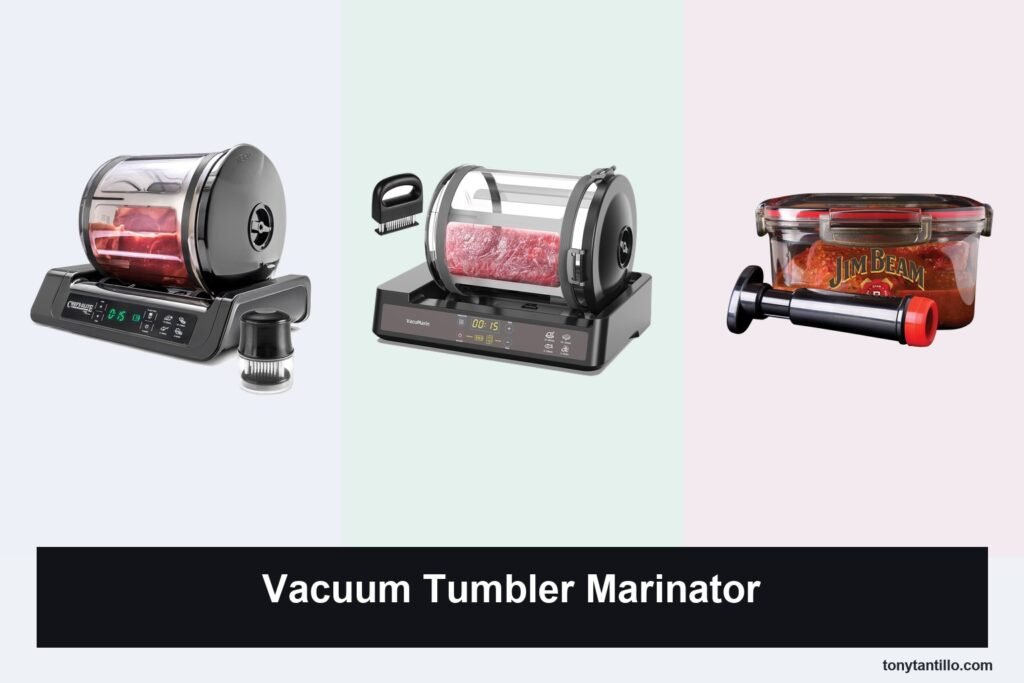
A vacuum tumbler marinator promises the thing most home cooks and small operators want but rarely get from a traditional soak: flavor that develops fast enough to fit an actual schedule. The category is built around vacuum pressure, rotation, and controlled timing, so the real buying question is not simply how quickly it marinates. It is how consistently it handles different foods, how easy it is to clean, and whether the machine matches the amount of food you prepare.
That is why the best options separate into very different use cases. Some are compact manual boxes that keep costs low and work well for casual batches. Others add powered rotation, preset timing, or commercial-capacity construction for more frequent use. The right pick depends on whether you value speed, simplicity, durability, or scale. The four recommendations below focus on the verified details that matter most in daily use, along with the tradeoffs that should shape your choice.
Top Vacuum Tumbler Marinator on the Market

STX Chef’s Elite Vacuum Marinator
Best Overall Speed
- 15-minute marinating system
- Motorized rotating vacuum base
- Includes meat tenderizer
- Auto shut-off timer
- Self-contained countertop design
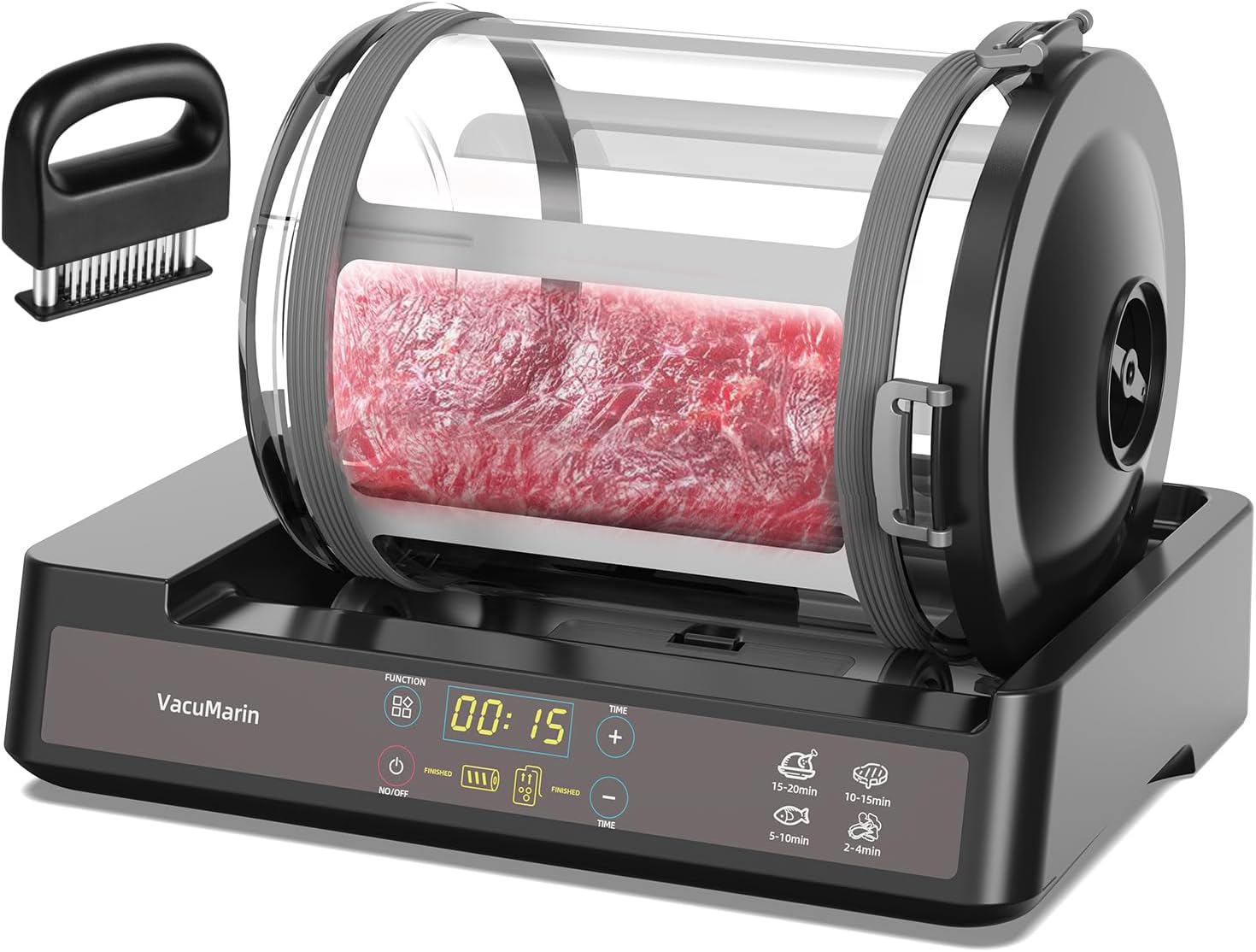
VacuMarin 15 Minute Tumbler
Best Budget-Plus Pick
- 15-minute rapid marinating
- Leak proof clip
- Digital display
- Vacuum hose storage
- Includes tenderizer

Jim Beam Vacuum Seal Box
Best Manual Choice
- Manual air-sealed pump
- Plastic construction
- 7.25-inch square footprint
- Hand wash recommended
- Compact for small batches

INTBUYING 38L Commercial Tumbler
Best Commercial Capacity
- 38L commercial capacity
- 304 stainless steel
- 0-99 minute timer
- 360° rotation
- 110V 350W power
Vacuum Tumbler Marinator Reviews
STX Chef’s Elite Vacuum Marinator
ADVANTAGES
LIMITATIONS
The STX International Chef’s Elite Vacuum Marinator & Tumbler is built for cooks who want fast turnaround without moving into commercial equipment. Its core selling point is the 15-minute marinating system, which makes the product useful for same-day dinner planning instead of overnight prep. The included meat tenderizer matters because the vacuum process is meant to move marinade into denser cuts, and the product’s own guidance points to perforating chicken breasts before processing. That combination gives it a more practical path to flavor penetration than a simple soak container.
Setup is straightforward because the system is self-contained and keeps the vacuum tubing in a storage compartment. That reduces the loose-parts problem that often makes countertop appliances feel messier than they need to be. The auto shut-off and adjustable processing guidance also help remove guesswork, especially when you are handling poultry, pork, vegetables, or other foods with different marinating needs. At 13 by 11 by 10 inches and 6.4 pounds, it sits in the middle of the countertop appliance range rather than disappearing into a cabinet, so buyers should think of it as a dedicated prep tool rather than an occasional novelty.
Against the smaller manual box in this roundup, the STX is the more capable choice when speed and repeatability matter more than price. It also avoids the scale and power demands of the commercial machine, which makes it far easier to justify for a home kitchen. The main tradeoff is cost, but that cost buys a motorized base, a rotating drum, and a more complete workflow. Best for fast home marinating is the clearest verdict here, especially if you want a stronger balance of convenience and performance than a basic vacuum box can offer.
VacuMarin 15 Minute Tumbler
ADVANTAGES
LIMITATIONS
This Vacuum Tumbler Marinator targets buyers who want a quick flavor boost but do not need the highest-end machine in the room. Its most relevant strength is the 15-minute rapid marinating approach, which puts it in the same speed class as pricier countertop units while staying more approachable on cost. The included free meat tenderizer helps bridge the gap between a compact appliance and the needs of thicker cuts, since denser meats are the place where rapid marination can otherwise fall short. That makes it a good fit for cooks who want a faster path to dinner without overcommitting to a large system.
The user-facing details are unusually practical. A leak proof clip addresses one of the most annoying failure points in marinating gear, especially when the container is being rotated or moved. The digital display and preset marination times reduce the chance of underprocessing or leaving food in the chamber too long. With vacuum hose storage built in, the unit is also easier to keep organized between uses. Its package size of 16.25 by 12.25 by 11.75 inches and 7.54-pound weight suggest a portable countertop device that still needs its own storage shelf, so it is compact by appliance standards but not truly minimal.
Compared with the STX unit, this one offers a more restrained, value-oriented path into powered vacuum marinating. It gives up some of the more established brand presence and still asks for counter space, but it counters that with a lower price point and a complete feature set that feels thoughtfully aimed at home use. The result is a solid middle-ground recommendation for households that want speed, a cleaner lid design, and a simple digital interface without moving up to the larger commercial class. Best value for fast marinating is the cleanest way to think about it.
Jim Beam Vacuum Seal Box
ADVANTAGES
LIMITATIONS
The Jim Beam Vacuum Seal Marinade Box is the most accessible entry in this group because it skips motors and timing electronics altogether. Its strongest appeal is the manual air-sealed pump, which keeps the system simple and inexpensive while still giving you the vacuum effect that drives faster flavor uptake. The 7.25-inch square footprint also makes it easier to store than the countertop appliances in this roundup, so it is the obvious candidate for smaller kitchens, occasional use, or anyone who wants a low-commitment way to try vacuum marinating.
Manual operation changes the experience in useful ways. You control how much air is removed, but the product also warns against over-pumping and notes that only a minimal amount of air should be removed if the box is going into the refrigerator. That means this is not a set-it-and-forget-it device, and it rewards users who will follow the process carefully. The plastic build and hand-wash care keep the cleanup routine uncomplicated, though they also make the box feel less substantial than powered stainless-steel alternatives. In exchange, you get a lighter tool that is easy to understand and quick to deploy for meat, poultry, fish, or vegetables.
This box sits at the opposite end of the roundup from the commercial tumbler and just below the powered home machines in overall convenience. It cannot match the speed, automation, or volume handling of the larger options, but it wins on simplicity and price. That makes it a smart choice for home cooks who want the vacuum marinating concept without buying into a larger appliance footprint. For occasional users, best low-cost entry point is the right conclusion, and it is especially compelling when storage space is tight.
INTBUYING 38L Commercial Tumbler
ADVANTAGES
LIMITATIONS
The INTBUYING 38L Commercial Meat Vacuum Tumbler Marinator is aimed squarely at businesses or serious batch processors. Its most decisive strength is the 38L commercial capacity, which puts it in a different category from the countertop machines above. The 304 stainless steel barrel also matters because commercial kitchens need equipment that can tolerate repeated use and easier sanitation. Add the 110V 350W electrical setup and you get a machine that is plainly designed for regular workflow rather than occasional weekend cooking.
The operating details reinforce that position. A 0-99 minute timer gives broad control over marinating cycles, while 360° rotation is intended to improve even seasoning distribution across larger loads. The hexagonal bucket shape is another meaningful design choice because it is meant to increase collision and friction efficiency inside the drum. That matters when the goal is to process meat or vegetables consistently at scale. At 27 by 16 by 32 inches and 66 pounds, this is not a portable countertop purchase. It needs dedicated space and a buyer who is prepared for a substantial footprint.
Compared with the smaller home machines, the INTBUYING unit trades convenience for throughput and durability. It is clearly the right answer when the priority is volume, not casual home prep. It also sits at the highest price point in the roundup, so its value depends entirely on how often you will use that capacity. For restaurants, cafeterias, and other food-service settings, the case is strong. For a home kitchen, it is difficult to justify unless you genuinely need the scale. Best for high-volume use is the straightforward recommendation.
How to Choose a Vacuum Tumbler Marinator
The best vacuum tumbler marinator is not just the fastest one. It is the machine that fits the way you cook, the foods you marinate most often, and the space you can actually spare. Vacuum marination changes the timing equation, but it does not erase the practical realities of cleanup, storage, and batch size. A compact manual box may be perfect for occasional use, while a motorized countertop system makes more sense when speed and repeatability matter. Commercial buyers need to think even harder about capacity, power, and durability.
Capacity and Batch Size
Start with the amount of food you actually marinate in a typical session. A small box is usually enough for a few portions, while larger tumblers make sense only when you regularly process bigger cuts or multiple servings at once. Oversizing can be just as wasteful as undersizing because a large chamber takes more storage space and usually costs more. Matching capacity to your real batch size keeps the machine useful instead of cumbersome.
Power and Automation
Power changes both convenience and consistency. Manual units are simpler and cheaper, but they depend on your own pumping and handling. Powered units add rotation, timers, and sometimes automatic shutoff, which can reduce guesswork and help produce more repeatable results. If you cook on a schedule and want less supervision, automation is worth paying for. If you marinate only occasionally, a manual system may be enough and easier to store.
Food Types and Penetration
Different foods respond differently to vacuum marination. Denser cuts often benefit from tenderizing or perforation because the marinade needs a path into the meat. More delicate foods can still gain from vacuum treatment, but the process should be matched to texture so you do not over-handle the ingredients. When a product includes a tenderizer or recommends one, that is a practical signal that the system is designed for harder-to-penetrate foods as well as simpler batches.
Cleanup and Storage
Cleanup matters more than many buyers expect. Smooth, removable, or easy-to-wash parts reduce the friction of using the machine often, while hose storage or self-contained layouts prevent accessories from getting lost. If your kitchen is short on space, look closely at the footprint and the weight. A compact manual model can disappear into a cabinet, while a larger powered tumbler may need a permanent corner on the counter or in a prep area.
Durability and Value
The right value choice depends on how often the machine will work. A lower-cost manual box can be excellent for occasional use, but frequent marinating puts more pressure on materials, seals, and moving parts. Stainless steel construction usually points toward easier long-term sanitation and a more serious duty cycle, while plastic designs tend to emphasize affordability and light weight. Think in terms of total usefulness over time, not just the purchase price on day one.
Comparison Table
| Product | Best For | Capacity | Weight |
|---|---|---|---|
| STX Chef’s Elite Vacuum Marinator | Best Overall Speed | 13 x 11 x 10 inches | 6.4 pounds |
| VacuMarin 15 Minute Tumbler | Best Budget-Plus Pick | Not Specified | 7.54 pounds |
| Jim Beam Vacuum Seal Box | Best Manual Choice | Not Specified | Not Specified |
| INTBUYING 38L Commercial Tumbler | Best Commercial Capacity | 27 x 16 x 32 inches | 66 pounds |
How We Tested & Analyzed Vacuum Tumbler Marinator
This roundup was built around category-level buying factors that actually affect daily use. Capacity, power source, timing controls, construction material, cleaning demands, and storage footprint were weighed as practical decision points because those details determine whether a vacuum marinating system feels convenient or burdensome after the first few uses. The goal was to identify where each design is strongest, not to flatten every option into the same checklist.
Meaningful differences were compared by looking at how the machines solve the same problem in different ways. Manual vacuum boxes, powered countertop units, and commercial tumblers all pursue faster flavor infusion, but they do so with different tradeoffs in setup, automation, and scale. That matters because a buyer choosing for a home kitchen has a very different priority set from a buyer outfitting a food-service environment. Each recommendation reflects that distinction rather than pretending the category is one-size-fits-all.
The analysis also accounts for limitations that should shape expectations. Faster marination does not automatically mean universal compatibility with every ingredient, and larger systems are not automatically better for every kitchen. The most useful conclusion for buyers is often the tradeoff itself: lower cost versus automation, compact storage versus higher capacity, or light-duty simplicity versus more robust construction. A good purchase is the one that best matches those priorities, not the one with the longest feature list.
Frequently Asked Questions
What does a vacuum tumbler marinator actually do?
It removes air around the food so marinade can move more quickly into the surface and, in some designs, deeper into the ingredients. The result is faster flavor development than a standard soak, especially when the machine also tumbles or rotates the food during the process.
Do all foods need the same marinating time?
No. Thicker or denser foods generally need more attention than softer or smaller pieces. Many vacuum systems are built around short cycles, but the right time still depends on the food type, the cut size, and whether the machine recommends tenderizing or perforation first.
Is manual or powered better?
Manual models are simpler, cheaper, and easier to store. Powered models are better when you want more repeatable results, rotation, and less hands-on attention. The better choice depends on whether you value convenience and consistency more than low cost and compactness.
What should I prioritize for kitchen space?
Focus on footprint, weight, and storage for hoses or accessories. A compact system is easier to keep accessible, which usually means you will use it more often. Larger units are worthwhile only if you have the counter or prep-area space to keep them out and ready.
Final Thoughts
A vacuum tumbler marinator is worth buying when speed, flavor penetration, and convenience matter enough to justify a dedicated appliance or container. The best choice is rarely the biggest or the cheapest one. It is the one that matches how much food you marinate, how much space you have, and how much control you want over the process. That is why the category includes everything from simple manual boxes to commercial stainless-steel tumblers.
If you are buying for a home kitchen, prioritize ease of use and storage before chasing maximum capacity. If you are equipping a serious prep environment, look harder at power, durability, and chamber size. The right vacuum marinating system should make cooking easier on ordinary days, not just impressive on the day it arrives. Choose the model whose strengths line up with your routine, and it will earn its place quickly.