
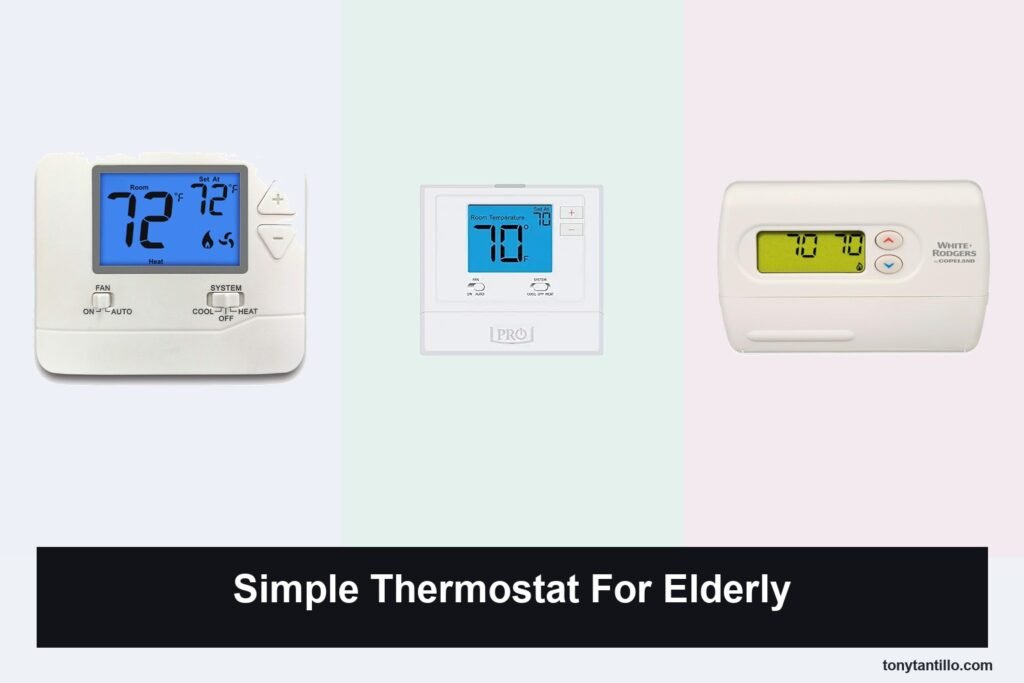
A simple thermostat can remove a surprising amount of daily friction. For older adults, the best choice is usually not the one with the most features. It is the one with the clearest display, the fewest decisions, and the least demanding setup. That matters because tiny buttons, buried menus, and advanced scheduling can turn a basic comfort upgrade into something frustrating to use every day.
This roundup focuses on straightforward non-programmable controls for standard 24-volt heating and cooling systems, plus one low-cost temperature and humidity monitor for buyers who mainly want easy room-condition checks. The strongest options here balance legibility, manual control, and practical installation details such as battery backup, standard footprints, and compatibility limits. The result is a tighter shortlist for households that value clarity first and complexity last.
Top Simple Thermostat For Elderly on the Market

ELECTECK 1H/1C Digital Thermostat
Best Budget Pick
- 1 heat/1 cool control
- 4.5-inch LCD display
- C-wire not required
- AAA or 24VAC power

PRO1 T701 Non-Programmable Thermostat
Best Display Readability
- 4-inch LCD display
- Blue backlight
- 2 AA batteries included
- 90% non-condensing humidity

White-Rodgers 80 Series Classic
Best Warranty Support
- Single-stage 1H/1C
- Large backlit display
- Three-year warranty
- Two AA batteries included

White-Rodgers 80 Series 1F83C-11NP
Best for Care Settings
- Built-in level
- Keypad lockout
- Adjustable temperature limits
- 4.5-inch backlit display

HATUSOKU Comfort Face Hygrometer
Best Room Monitor
- Temperature and humidity readings
- Comfort face display
- Magnet, stand, or hanging
- AAA battery power
Simple Thermostat For Elderly Reviews
ELECTECK 1H/1C Digital Thermostat
ADVANTAGES
LIMITATIONS
The ELECTECK Non-Programmable Digital Thermostat, 1 Heat/1 Cool, Big LCD, White is the most affordable straightforward option in this group, and its value comes from keeping the interface simple rather than adding extra logic. The 4.5-inch LCD display and big separate buttons reduce the chance of misreads or accidental settings changes. That is especially useful when the thermostat needs to be adjusted by someone who does not want to navigate menus. Its single-stage 1 heat/1 cool design is also a good fit for homes with basic conventional equipment.
Setup is uncomplicated for a standard low-voltage system because it runs on 24VAC or two AAA batteries, and it does not require a C-wire. That combination lowers the installation burden when wiring access is limited. The thermostat also includes a 5-minute compressor delay protection feature and separate heating and cooling swing adjustments, which are practical details for system protection and temperature consistency. The tradeoff is clear, though. It is not for baseboard, line-voltage, multi-stage, mini-split, or auxiliary-heat heat pump systems.
Among the thermostats in this roundup, this one is the most cost-conscious and the most stripped back. That makes it attractive for a buyer who wants a readable wall control without paying for a more elaborate feature set. It does not bring the heft of a long warranty statement or the more polished legacy-brand positioning of the pricier options, but it does cover the fundamentals well. For a simple, low-friction thermostat on a conventional system, this is the easiest recommendation when budget is the main concern.
PRO1 T701 Non-Programmable Thermostat
ADVANTAGES
LIMITATIONS
The PRO1 T701 24 V, 4 INCH Display, 90% Non-CONDENSING Humidity, Blue Backlight, Non-PROGRAMMABLE, Thermostat is built around visibility. The 4-inch LCD display is compact but still large enough to keep core temperature information front and center, and the blue backlight improves readability in dim rooms. That combination matters when a thermostat needs to be checked quickly without straining to see small characters. Its push-button control keeps the interface direct, so there is no learning curve tied to programming or advanced mode switching.
This model uses 24-volt wiring and is battery powered, with two AA batteries included. That means the unit can be installed on standard HVAC systems without adding a complex power accessory. The humidity tolerance of 90% non-condensing matters in practical terms because it signals better resilience in damp mechanical environments than a thermostat with no stated humidity handling. It is still a wall-mount conventional control, so it belongs with standard HVAC equipment rather than specialty systems.
Compared with the budget option, the PRO1 T701 feels more polished in the day-to-day viewing experience, but it does not lean on extra features to earn that difference. Compared with the White-Rodgers models, it lacks a long warranty statement and advanced lockout controls. Its strength is more focused: clear display, straightforward operation, and a conventional power setup. For someone who values easy reading above all else and wants a clean, no-frills thermostat, this is the most display-centric pick in the set.
White-Rodgers 80 Series Classic
ADVANTAGES
LIMITATIONS
The White-Rodgers 80 Series Classic, Non-Programmable, Single Stage (1H/1C) Thermostat, 1F86-344 is the strongest choice for buyers who want a familiar interface backed by a more reassuring warranty story. Its large backlit display is easy to read in low light, and the single-stage 1H/1C design keeps the control logic uncomplicated. The result is a thermostat that should feel approachable even for someone who does not want to think about schedules or modes. The inclusion of a filter indicator and low battery indicator also adds useful maintenance reminders without making the thermostat feel busy.
Its setup story is one of the better ones in this group because it uses a straightforward set-up menu and standard footprint. Two included AA batteries reduce the chance of an immediate extra purchase. The thermostat is built for single-stage heating and cooling, including heat pump systems without auxiliary heat, so compatibility is solid for the right home but not broad enough for every configuration. The 1-degree accuracy claim is another practical advantage. It supports tighter temperature control without turning the user interface into a technical exercise.
Against the ELECTECK, this White-Rodgers unit costs more but adds more confidence through the warranty and a more established product position. Against the PRO1, it gives up some display sizing drama but compensates with maintenance prompts and a cleaner long-term support story. The main limitation is the same one common to several simple thermostats in this roundup: it is still a standard single-stage control, not a universal solution. For a buyer who wants a clearly readable thermostat with stronger ownership peace of mind, this is an excellent middle-ground choice.
White-Rodgers 80 Series 1F83C-11NP
ADVANTAGES
LIMITATIONS
The White-Rodgers 80 Series, Non-Programmable Thermostat, 1F83C-11NP is the most controlled-feeling option in the set, which makes it especially relevant for households where a caregiver or family member wants to limit accidental changes. The keypad lockout and adjustable heat/cool temperature limits are the standout features here. They reduce the risk of someone turning the system too far up or down. The 4.5-inch backlit display also keeps the basic reading experience accessible, so the added controls do not come at the cost of visibility.
Installation is helped by a built-in level and a standard footprint, both of which make setup more straightforward than a thermostat that depends on precise visual alignment. It runs on two included AA batteries and 24-volt power, so it remains a conventional wall control for standard HVAC systems. Like the other White-Rodgers model, it works with single-stage heating and cooling and heat pump systems without auxiliary heat. That keeps it usable in the right home, but it still excludes more complex systems.
This is the most sensible recommendation when preventing accidental adjustment matters as much as readability. It does not rely on schedules to manage comfort, and it does not try to be a smart thermostat. Instead, it adds restraint through lockout and limit controls. Compared with the budget pick, it is more protective. Compared with the more basic PRO1, it is better suited to shared households or care environments. That makes it the best fit for a senior who benefits from simplicity, but whose system should not be easy to misconfigure.
HATUSOKU Comfort Face Hygrometer
ADVANTAGES
LIMITATIONS
The HATUSOKU Digital Thermometer and Hygrometer with Comfort Face Display, Hygrometer, Stand, Magnet, Hanging, Simple, Infectious Disease Prevention, Heat Stroke Prevention (Simple, No Clock) is not a thermostat, but it earns a place here for buyers who mainly want an extremely easy room-condition monitor. The comfort face display and simple temperature-humidity readout are the key benefits. They let a user check whether a room feels dry, comfortable, or humid without interpreting a dense interface. The small size also makes it easy to place where a quick glance is most useful.
Its practical value comes from the mounting flexibility. A magnet, stand, or hanging option means it can go on a refrigerator, a tabletop, or a wall hook without special hardware. It runs on AAA batteries rather than button cells, which is a real usability advantage for older users because replacements are easier to find and handle. The stated temperature and humidity ranges are broad enough for everyday indoor monitoring. The tradeoff is that it measures conditions rather than controlling them, so it supports comfort decisions instead of replacing HVAC control.
Compared with the thermostat options in this roundup, this is the least similar product and the least useful if you need actual heating or cooling control. Still, it is the most approachable if the real need is a room monitor with almost no learning curve. The no-clock design keeps the screen simple, and the comfort icon makes interpretation even easier. For a bedroom, living room, or care space where fast visual confirmation matters more than automation, this is a useful add-on rather than a substitute for a thermostat. That makes it the clearest non-thermostat option for the right buyer.
How to Choose a Simple Thermostat
The right simple thermostat should make the room easier to manage, not add another device to learn. For an elderly user, the priority is usually a clear screen, dependable manual control, and a setup that does not ask for constant attention. That means the best choice is often the one that trims away scheduling, remote app control, and unnecessary modes. A good model should still match the home’s heating and cooling system exactly, because compatibility matters more than convenience features when a thermostat is meant to be used every day.
Readability First
Large digits and strong contrast matter more than most buyers expect. A thermostat may be mounted across the room or in a hallway with poor lighting, so the display needs to be legible at a glance. Backlighting can help at night, but the character size and screen layout are just as important. A clean screen with clear temperature information is easier to trust and easier to use, especially for someone who prefers a quick check over a menu-driven setup.
Manual Control Simplicity
A non-programmable thermostat usually works best when the user wants one clear adjustment path. Buttons should be obvious, and the controls should not force the user through layers of menus. That matters in homes where comfort settings change by feel rather than by schedule. Manual control also lowers the chance of confusion after a power outage or battery change. If the goal is everyday ease, fewer modes are usually better than more automation.
System Compatibility
The thermostat has to match the heating and cooling equipment before anything else matters. Standard low-voltage thermostats suit many conventional furnaces, air conditioners, and single-stage heat pumps, but they are not the right choice for every system. Line-voltage heat, multi-stage equipment, and auxiliary-heat setups often need different controls. Checking compatibility first prevents installation trouble and avoids buying a thermostat that looks simple but does not work with the home’s system.
Installation Burden
An older user may not want a complicated setup process, and the installer may face wiring limitations. Battery power can simplify matters, while a C-wire requirement can create extra work. A standard footprint and included mounting hardware also reduce friction. Features such as a built-in level, wire labels, or a straightforward setup menu can shorten the process and reduce the chance of mistakes. If installation needs to stay painless, those details deserve real attention.
Protection and Limits
Some simple thermostats add lockout features, temperature limits, or delay protection. Those details can be very useful in shared homes or care settings because they reduce accidental changes and protect equipment from rapid cycling. On the other hand, more protective controls are not always the simplest to adjust during setup. The right balance depends on who will use the thermostat most often. If the user needs freedom, keep the controls basic. If accidental changes are a concern, choose a model with guardrails.
Monitor or Controller
Not every buyer needs a thermostat. Sometimes the real need is an easy way to check temperature and humidity in a bedroom, living room, or care space. In that case, a room monitor can be more useful than a control device because it gives fast feedback without changing HVAC operation. If you need heating or cooling changes, choose a thermostat. If you only need visibility into room conditions, a simple thermometer-hygrometer may be the more practical choice.
Thermostat Comparison Table
| Product | Best For | Display | Screen Size | Control Type | Power | Color |
|---|---|---|---|---|---|---|
| ELECTECK 1H/1C Digital Thermostat | Best Budget Pick | LCD | 4.5 inches | Single Stage 1 Heating and 1 Cooling | Electric | White |
| PRO1 T701 Non-Programmable Thermostat | Best Display Readability | LCD | 4 inches | Non-Programmable | Battery Powered | Blue |
| White-Rodgers 80 Series Classic | Best Warranty Support | LCD | Not Specified | Manual | Battery Powered | White |
| White-Rodgers 80 Series 1F83C-11NP | Best for Care Settings | LCD | 4.5 inches | Manual | Battery Powered | White |
| HATUSOKU Comfort Face Hygrometer | Best Room Monitor | Not Specified | Not Specified | Not Specified | Not Specified | White |
How We Tested & Analyzed Simple Thermostat for Elderly
This roundup focused on the decision points that matter most when a thermostat needs to stay simple. Display clarity, button layout, control logic, and compatibility with standard HVAC systems carried more weight than feature count. Battery power, installation aids, and maintenance prompts were also important because they influence whether the thermostat stays easy to live with after the first setup is complete. The goal was to judge which options reduce friction in real use, not which ones look most capable on paper.
The comparison also emphasized the consequences of design choices. A larger screen is not valuable only because of its size. It matters because it can be checked quickly from across a room. A lockout feature is not useful only as a line item. It matters because it can keep settings from being changed accidentally. Likewise, a thermostat with broader compatibility still has to be matched carefully to the home’s actual equipment. That is why the analysis separates convenience from fit.
Limitations were weighed honestly. A simple thermostat should not be treated as universal, and it should not be judged as though smart controls or multi-stage support are always desirable. In some homes, the best choice is the one that does less. The recommendations therefore favor legibility, straightforward operation, and clear system boundaries. Where a product is actually a room monitor rather than a thermostat, that distinction is treated as a functional difference rather than a minor detail.
Frequently Asked Questions
What makes a thermostat easier for an older adult to use?
A large display, simple button controls, and a non-programmable interface usually matter most. Those features reduce the number of steps needed to make a change and make the current temperature easier to read. Battery backup can also help because the thermostat stays usable even if wiring access is limited or the installation is basic.
Do simple thermostats work with every heating system?
No. Compatibility depends on the home’s equipment. Many simple thermostats are made for standard low-voltage furnace, air conditioner, or single-stage heat pump systems. They are usually not appropriate for line-voltage heat, multi-stage systems, or setups that require auxiliary heat control. Matching the thermostat to the system is the first step.
Is a programmable thermostat better for seniors?
Not necessarily. Programmable models can help in some homes, but they also add steps and settings that may not be needed. For many older adults, a non-programmable thermostat is easier because it behaves predictably and does not require schedule management. Simplicity is often more valuable than automation when the goal is everyday comfort.
When is a room monitor better than a thermostat?
A room monitor is better when you only want to check temperature or humidity, not control heating or cooling. That can be useful in bedrooms, living rooms, or care spaces where quick visibility matters. It is especially helpful if the goal is comfort awareness rather than HVAC adjustment. If control is required, though, you still need a thermostat.
Final Thoughts
For a simple thermostat aimed at elderly users, the best choice is usually the one that removes uncertainty. Readable screens, direct controls, and compatibility with the home’s actual system matter more than fancy scheduling or remote features. In many cases, the right thermostat is the one that feels obvious the first time it is used and still feels obvious months later. That is the standard these picks are meant to meet.
The safest path is to start with the system type, then weigh readability and installation ease, and only after that look at extras such as lockout controls or warranty support. A good simple thermostat should be easy to trust, easy to adjust, and hard to misuse. If the need is only to monitor room conditions, a separate hygrometer may be enough. If the need is to control comfort, choose the clearest compatible thermostat and keep the interface as plain as possible.