
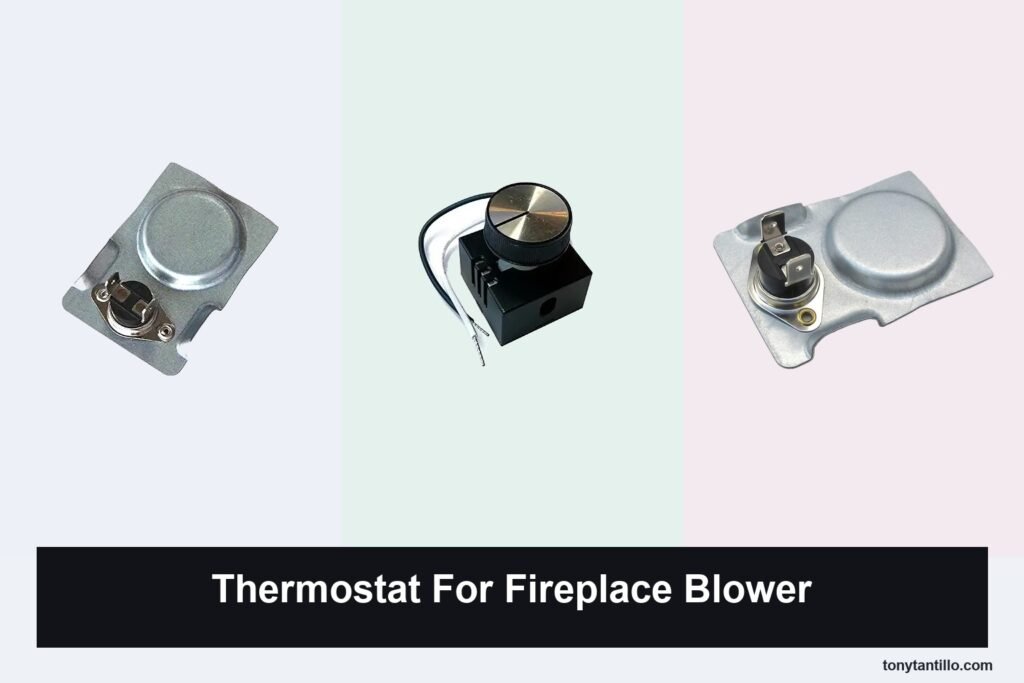
A fireplace blower works best when it turns on at the right time and at the right speed. Too little control and you waste heat or hear unnecessary fan noise. Too much control and you complicate a system that should be simple, reliable, and automatic. The right thermostat for fireplace blower use depends on how your hearth is built, whether you want a pure temperature-triggered switch or a fuller control system, and how much installation effort you can accept.
This roundup focuses on practical buying decisions. Some options are small magnetic snap-disc thermostats that automate a blower with almost no hardware. Others combine thermostat control with speed adjustment or a remote receiver system. The key differences are fit, wiring, temperature behavior, and how much control you want over blower noise and runtime. I looked for the clearest verified strengths in each product and the tradeoffs that matter once the unit is installed.
Top Thermostat For Fireplace Blower on the Market

Hongso Magnetic Thermostat Switch
Best Simple Pick
- Magnetic mount
- 120°F on threshold
- 90°F shutoff
- Fireplace blower compatible

Midwest Hearth Blower Speed Control
Best Speed Control
- 115V 3.0A rating
- Variable speed with off
- Panel mount rheostat
- Knob included

Wemordu Magnetic Thermostat Switch
Best Budget Pick
- Magnetic mount
- 120°F activation
- 90°F shutoff
- Fits blower kits

Skytech Backlit Fireplace Remote
Best Remote Control
- Programmable thermostat
- Backlit LCD
- Battery powered receiver
- RF control

Durablow Magnetic Ceramic Thermostat
Best Durable Build
- Ceramic sensor block
- Stainless steel 430
- 120°F activation
- 2-year warranty

DN125 Magnetic Thermostat Switch
Best Minimal Retrofit
- Magnetic mount
- 120°F activation
- No bracket needed
- Compact 2-inch size

Skytech Fireplace Remote Thermostat
Best Cordless Option
- RF remote control
- LCD temperature display
- AA batteries included
- Learn function receiver

Adviace Automatic Thermostat Sensor
Best Wiring Package
- High-temperature wiring
- 120°F activation
- Magnetic mount
- Female terminals installed

Adviace GFK-160A Blower Kit
Best Full Replacement
- 160 CFM airflow
- Ball bearing motor
- Magnetic thermostat included
- 83-inch power cord
Thermostat For Fireplace Blower Reviews
Hongso Magnetic Thermostat Switch
ADVANTAGES
LIMITATIONS
The Hongso switch is the kind of solution that keeps a fireplace blower uncomplicated. Its automatic operation and normally open contact style mean the fan stays idle until heat is present, then closes at about 120°F and opens again around 90°F. That temperature window is a practical fit for systems that should wait for usable warmth before moving air. The compact 2 1/2-inch by 1 3/4-inch size also matters because it keeps the control easy to place without crowding the firebox area.
Installation stays straightforward because the thermostat uses a magnetic mount and does not require screws or nuts. That matters for buyers replacing a failed snap-disc style part or adding automatic control to a blower kit without wanting to drill or rebuild anything. The metal construction and screw terminal setup keep the part firmly in the replacement-parts lane rather than the remote-control lane. One limitation is baked into its behavior: the blower will not start until the thermostat has heated to roughly 120°F, so this is not for people who want immediate manual fan activation.
Against the fuller control systems in this roundup, the Hongso is the stripped-down option. You do not get speed adjustment, a remote, or a programmable schedule. What you do get is a small automatic switch that is easy to understand and easy to live with. That makes it the best fit for buyers who want the blower to turn on and off by temperature alone and who value a simple replacement over extra features. For that job, it is an easy recommendation.
Midwest Hearth Blower Speed Control
ADVANTAGES
LIMITATIONS
Midwest Hearth is aimed at buyers who want to tune blower output instead of simply letting it run when hot. The standout detail is the variable speed rheostat with a true off position, which means you can quiet a blower for background heat or shut it down completely when the fireplace is not in use. The 115V and 3.0A rating define the electrical lane this control belongs in, so it is geared toward compatible AC blower setups rather than universal guesswork. The included knob and mounting nut also turn it into a more complete replacement package.
Its panel-mount design matters as much as the electronics. This style is intended to fit pre-drilled OEM rheostat holes, so the deciding question is not whether the control is good, but whether your fireplace panel already has a compatible opening. The body size is small enough to avoid a bulky retrofit, and the 6-inch lead wires keep the wiring manageable. RoHS compliance is another useful sign for shoppers who prefer a standards-conscious replacement part. The tradeoff is that this is not a thermostat by itself. It controls speed, not heat-triggered automation.
Compared with the magnetic snap-disc options here, this control is for a different buyer. It gives you manual authority over blower noise and airflow, but it will not automatically switch based on firebox temperature. That makes it a better choice when you already have automatic heat sensing or when you simply want direct speed control on a compatible blower. If your priority is fine-tuning airflow and eliminating the hard-on, hard-off feel of simpler parts, this is the strongest fit in the group.
Wemordu Magnetic Thermostat Switch
ADVANTAGES
LIMITATIONS
This Wemordu thermostat switch focuses on the core job at a very low price point. It is a magnetic mount switch for fireplace blower fans, wood stoves, and gas log fireplaces, and its activation range is the familiar 120°F on and 90°F off pattern found in this category. That makes it a straightforward automatic trigger rather than a complicated controller. The compact 2.5-inch by 1.5-inch footprint keeps it unobtrusive, and the metal build supports the use case of a small replacement switch sitting near heat.
The biggest practical advantage is how little installation burden it adds. No screws or nuts are required, so the part is meant to stick in place and do its job without a more permanent retrofit. That is useful for quick replacements or for users who want automatic blower behavior without touching the existing panel controls. The product description also notes optional speed control compatibility, which means you can pair this switch with a rheostat if you already use one. The downside is that this is still a temperature switch, not a speed controller, so it solves automation rather than tuning.
Among the nine products here, this one is one of the most cost-conscious paths to automatic blower operation. It is simpler than remote systems and less expensive than a full blower kit. It also lacks the broader build details and upgraded wiring of some rivals, so it makes sense when budget and straightforward function matter more than extra installation convenience. For a low-cost temperature trigger, it is an easy short-list candidate.
Skytech Backlit Fireplace Remote
ADVANTAGES
LIMITATIONS
Skytech takes the category in a very different direction. Instead of a small thermostat switch mounted near the firebox, this is a programmable remote system with thermostat control, a backlit LCD, and a receiver that can be installed in the wall, on the hearth, or under the fireplace behind the access panel. That flexibility changes the whole user experience because the control point moves away from the firebox and into the room. For buyers who want convenience and a cleaner daily routine, that is a major distinction.
The receiver uses a learn function and an On/Remote/Off slider, while the transmitter adds five buttons and a flip cover. Those details matter because they suggest a system designed for both manual and thermostatic use rather than a one-mode gadget. The backlit display shows room temperature, set temperature, and a 24-hour clock, which is useful when you want the fireplace to respond to conditions in the room instead of only to the firebox. The obvious limitation is cost. This is much more expensive than a snap-disc thermostat and is only sensible for compatible fireplace systems.
Compared with the simple magnetic switch options, this is the premium choice for someone who wants remote-based operation and a richer control interface. It is not the right answer when all you need is a blower to turn on with heat. It is the right answer when the goal is comfort, convenience, and a thermostat-style control experience from across the room. For that buyer, it justifies its place in the lineup.
Durablow Magnetic Ceramic Thermostat
ADVANTAGES
LIMITATIONS
Durablow stands out because it is built around heat resistance rather than just basic switching. The combination of stainless steel 430 and a high heat resistant ceramic sensor block is the clearest reason to consider it when durability matters. The thermostat activates at about 120°F and shuts off at about 90°F, so it follows the standard blower-control pattern while using upgraded materials around the sensor. That matters for buyers who want a replacement part that feels more engineered for heat exposure than the cheapest magnetic switches.
The installation approach is also simple. It uses a magnetic mount and does not need screws or nuts, so the thermostat is still aimed at fast replacement rather than complicated wiring. Its 2.7 x 2 x 0.8-inch size is compact enough for a hidden placement near the firebox. The 2-year warranty is another concrete advantage, especially in a category where many low-cost parts are sold without much visible support. One thing to note is that the product is still a thermostat switch, not a speed controller, so it handles timing rather than airflow tuning.
Against the other temperature switches in this roundup, Durablow is the one that most clearly leans into material quality. It is not the cheapest, and it is not the most feature-rich, but it gives you a sturdier hardware story than a basic magnetic disc alone. That makes it a sensible middle ground for buyers who want a long-term replacement part and are willing to pay a little more for the upgraded sensor construction. I would place it near the top for durability-minded shoppers.
DN125 Magnetic Thermostat Switch
ADVANTAGES
LIMITATIONS
The DN125 is stripped down to the essentials, which is exactly why some buyers will prefer it. It is a magnetic thermostat switch for fireplace fan and blower kits, and it is designed to operate without a bracket. The 120°F activation and 90°F shutoff follow the standard on-demand blower pattern. The compact 2 x 2 x 2-inch dimensions keep it unobtrusive, and the 1.76-ounce weight suggests a very light replacement part rather than a heavy control assembly.
Because it is so minimal, the installation story is simple. The magnetic mount is meant to stick in place without extra hardware, which reduces the chance of a messy retrofit. That makes it useful when you just need automatic heat sensing and do not want a control that changes the appearance of the fireplace area. The tradeoff is that this product record provides less supporting detail than some rivals. There is no added wiring bundle, no speed control, and no explicit durability upgrade in the way some more developed models advertise.
Relative to the more feature-rich thermostat and blower systems here, the DN125 is the basic maintenance replacement. It does not try to be clever. It just supplies the thermal on/off function needed by many blower kits. That is a strength for anyone who wants the simplest possible swap and is comfortable verifying fit on their own. If you want a compact, no-frills magnetic thermostat, this is one of the cleanest choices.
Skytech Fireplace Remote Thermostat
ADVANTAGES
LIMITATIONS
This Skytech system is the cordless answer for buyers who want fireplace control from the room instead of from the hearth. It operates by radio frequency and includes a four-button transmitter with On, Off, Mode, and Set functions. The LCD display shows room and thermostat temperature in Fahrenheit or Celsius, so it supports a more flexible level of monitoring than a basic heat-triggered switch. Battery operation is also a key convenience feature because the kit ships with four AA batteries included.
The receiver’s learn function and snap-on wall plate matter because installation is clearly meant to be tidy and modular. The 10-meter maximum range gives a realistic sense of how far away the control can be used, and the system can support up to three devices, which increases usefulness for a multi-unit setup. That said, this is not a blower-only thermostat. It is a fireplace remote and thermostat package, so it belongs in the broader hearth-control category rather than the simple snap-disc replacement lane.
Compared with the lower-cost magnetic thermostat switches, this is for buyers who want to manage the fireplace more like a room appliance. It costs far more, but it also removes the need to reach the firebox to adjust control settings. That convenience has real value if you are replacing an older remote or if your fireplace setup benefits from cordless operation. For buyers who prioritize remote flexibility and a more polished control experience, it belongs near the top of the list.
Adviace Automatic Thermostat Sensor
ADVANTAGES
LIMITATIONS
Adviace is one of the most complete automatic thermostat sensor packages in the group. The biggest advantage is the included wiring: two 55.5-inch strands of heat-tolerant wire with female terminals already installed at both ends. That matters because it reduces the odds of hunting for separate connectors during a replacement. The magnetic thermostat itself measures 2 1/2 inches by 1 3/4 inches, and the usual 120°F on and 90°F off behavior keeps the blower logic simple and predictable.
The installation flexibility is stronger than many basic snap-disc replacements. The magnetic mount means no drilling, and the sensor can be moved around the underside or side of the firebox. Compatibility is broad, covering fireplace blower fan kits, gas log fireplaces, wood stoves, gas stoves, pellet stoves, vent-free gas heaters, and more. The tradeoff is that the broader compatibility list also means the buyer still has to think carefully about fit and layout. A universal claim does not remove the need to confirm where the sensor and wires will sit in your setup.
Against the simpler magnetic thermostats in this roundup, Adviace wins on practical installation support. Compared with the remote-control systems, it is far more focused and much easier to understand. That combination makes it the strongest choice for someone who wants automatic blower operation and values a complete replacement bundle. If the priority is a thermostat sensor with real installation convenience rather than just a bare switch, this is the one I would favor.
Adviace GFK-160A Blower Kit
ADVANTAGES
LIMITATIONS
This Adviace kit is more than a thermostat. It is a full blower replacement package built around a 160 CFM ball bearing blower, a magnetic automatic thermostat sensor, and a rheostat variable speed controller. That combination immediately changes the buyer profile. Instead of replacing one control piece, you are replacing the blower assembly and getting the control stack with it. The 120-volt, 60 Hz electrical setup and 192-watt rating place it squarely in the dedicated fireplace blower category, and the 2700 RPM motor speed explains why it is intended to move heat actively rather than subtly.
The built-in thermostat and variable speed control are the practical highlights. The magnetic thermostat turns the blower on and off with firebox heat, while the rheostat lets you reduce noise or run the blower harder when you want stronger circulation. Rubber isolation feet are included to reduce noise and vibration, and the 83-inch power cord gives more flexibility in routing than a short lead would. The flush-mount installation style and the broad compatibility list mean this kit is aimed at specific fireplace models, so fit verification matters much more here than with a small standalone thermostat.
Compared with the other products in this roundup, this is the most complete solution for someone replacing a worn-out blower system. It costs more, but it also bundles airflow, thermostat logic, speed control, and installation hardware in one package. Buyers who want a one-and-done replacement should look here first. If you only need a sensor switch, this is more than you need. If you need the blower itself, though, it is the clearest full-system option in the list.
How to Choose a Fireplace Blower Thermostat
A fireplace blower thermostat is a small part with an outsized effect on comfort. Get the control logic wrong and the fan can run too soon, run too loudly, or fail to start when the firebox is actually hot enough to use. The best choice depends on whether you need a simple heat-triggered switch, a manual speed controller, or a broader remote system. Installation style matters just as much as electrical behavior, because a good fit can save you from drilling, rewiring, or replacing more of the fireplace than you intended.
Control Style
Start with the kind of control you actually need. A thermostat switch turns the blower on and off based on heat, which suits buyers who want automation and little else. A rheostat changes fan speed, which is useful when noise matters or when you want to modulate airflow rather than simply trigger it. Remote systems add convenience and room-level control, but they also add cost and complexity. The right answer depends on whether your priority is simple automation or more complete control of the fireplace experience.
Mounting Fit
Mounting style often determines whether a part is easy or frustrating to install. Magnetic thermostats are attractive because they avoid drilling and can usually be placed quickly on the firebox surface. Panel-mount controls depend on existing openings and can be excellent when the fireplace was designed for them. Full blower kits demand the most planning because they replace hardware rather than just a switch. Before buying, match the control’s physical mounting method to the way your fireplace is already built.
Temperature Behavior
The activation and shutoff temperatures matter more than many shoppers expect. A blower that comes on too early can push cool air into the room, while one that waits too long can miss some of the heat you were trying to circulate. The common 120°F-on and 90°F-off pattern is popular because it lets the firebox warm up first and then keeps the blower running as the unit cools. That behavior is usually better than a manual guess, especially for everyday use.
Wiring and Power
Wiring needs vary widely in this category. Some controls are simple replacement switches that attach with minimal hardware. Others include lead wires, connectors, or complete power cords. Power rating and voltage should also match the blower system you are working with, because a control that is not aligned with the electrical load can create installation problems. A slightly more complete wiring package can save time, but only if it matches the equipment already in the fireplace.
Noise and Runtime
Noise control is a real buying factor, not a luxury detail. A basic thermostat gives you automatic operation, but it does not let you decide how aggressively the blower moves air. A variable-speed control can reduce fan noise and make the fireplace feel less mechanical at low settings. Full blower kits add another layer by pairing speed control with vibration reduction and a matched fan assembly. If you use the fireplace often in a living space, the quieter option may be the one you appreciate most over time.
Replacement Scope
Decide whether you are replacing a switch or the whole blower system. A thermostat-only purchase makes sense when the fan still works but needs better automation. A speed control is right when the blower is functional but too loud, too abrupt, or lacking an off position. A full kit is the answer when the fan assembly itself is worn or when you want the thermostat, wiring, and blower matched together. Choosing the smallest necessary repair usually keeps cost and installation effort under control.
Fireplace Blower Comparison Table
| Product | Best For | Mounting | Color | Controller Type | Item Weight | Control Method |
|---|---|---|---|---|---|---|
| Hongso Magnetic Thermostat Switch | Best Simple Pick | Fireplace / Stove Mount | black | Automatic Shutoff | 1.12 ounces | Voice |
| Midwest Hearth Blower Speed Control | Best Speed Control | Panel Mount | Black | Rheostat Knob | 2 ounces | Touch |
| Wemordu Magnetic Thermostat Switch | Best Budget Pick | Magnetic Mount | Blue | Button Control | 0.04 kg | Not Specified |
| Skytech Backlit Fireplace Remote | Best Remote Control | Not Specified | Gray | Button Control | 12.96 ounces | Not Specified |
| Durablow Magnetic Ceramic Thermostat | Best Durable Build | Ceiling Mount | Silver | Push Button | Not Specified | Sensor |
| DN125 Magnetic Thermostat Switch | Best Minimal Retrofit | Not Specified | Not Specified | Not Specified | 1.76 ounces | Not Specified |
| Skytech Fireplace Remote Thermostat | Best Cordless Option | Not Specified | Black | Button Control | 12 ounces | Not Specified |
| Adviace Automatic Thermostat Sensor | Best Wiring Package | Insert,Wall Mount | Silver | Push Button | 2.39 ounces | App |
| Adviace GFK-160A Blower Kit | Best Full Replacement | Flush Mount | Black | Button Control | Not Specified | Touch |
How We Tested & Analyzed Thermostat for Fireplace Blower
This category was evaluated around practical buying criteria rather than feature volume alone. The main questions were how each product controls blower behavior, how much installation effort it is likely to demand, and whether the physical mounting approach fits a fireplace or blower application cleanly. I also weighed electrical compatibility, included hardware, and whether the product solved a narrow thermostat need or a broader blower-control problem. That matters because fireplace buyers are usually trying to fix a specific comfort issue, not shop for general-purpose components.
Meaningful differences in this category often come down to control scope. A simple magnetic thermostat and a remote receiver may both involve fireplace heat management, but they solve very different problems. For that reason, the analysis separated automatic temperature switching from speed control and remote operation instead of treating them as interchangeable. I also paid attention to implementation details such as lead wires, mounting style, and whether the control package included everything needed for a normal replacement, since those details often determine real-world value more than a headline feature.
This roundup also accounts for the limits of product records in a specialty category. Some controls provide clear temperature thresholds and fit details, while others emphasize bundled accessories or broader compatibility. Where the evidence was strong, the analysis used it directly. Where it was sparse, the recommendation stayed conservative and focused on the verified use case rather than overreaching. That approach keeps the guidance grounded in the actual decision a buyer has to make: simple switch, adjustable control, remote system, or full blower replacement.
Frequently Asked Questions
What temperature should a fireplace blower thermostat use?
A common pattern is for the blower to turn on around 120°F and turn off around 90°F. That range lets the firebox warm up before the fan starts moving air and keeps the blower running while the unit cools. The best setting is the one that matches your blower design and your comfort goals, but this range is widely used because it balances heat recovery and convenience.
Is a magnetic thermostat easier to install?
Usually, yes. Magnetic thermostats are popular because they can attach without drilling or screws, which makes them much easier to place on or near the firebox. That simplicity is useful for replacement work and for buyers who want automatic blower control without a major retrofit. The tradeoff is that you still need to confirm fit and placement around your fireplace layout.
Do I need a speed control or just a thermostat?
If your only goal is to automate blower operation, a thermostat is usually enough. If you also want to change how loudly the fan runs or how hard it pushes heat, then a speed control is worth considering. The two parts solve different problems, so the better choice depends on whether your concern is timing, airflow, or both.
When is a full blower kit worth it?
A full blower kit makes sense when the fan assembly itself is worn, noisy, or incomplete, not just when the control switch has failed. It is also useful if you want the blower, thermostat, wiring, and speed control to come from one matched package. That costs more and takes more installation effort, but it can simplify a bigger repair.
Final Thoughts
The best thermostat for fireplace blower use depends on how much control you want and how much of the fireplace system needs replacement. A small magnetic thermostat is the simplest route when you only need automatic on and off behavior. A rheostat or remote system is better when comfort, noise, or convenience matters more than basic automation. The smartest choice is the one that matches your fireplace’s wiring, mounting style, and repair scope.
If you want the least complicated fix, choose a compact magnetic switch. If you want to shape blower noise or airflow, move up to a variable controller. And if the blower assembly itself is tired, a full kit is the more complete solution. Once you separate those needs, the category becomes much easier to shop, and the right part is usually obvious.