
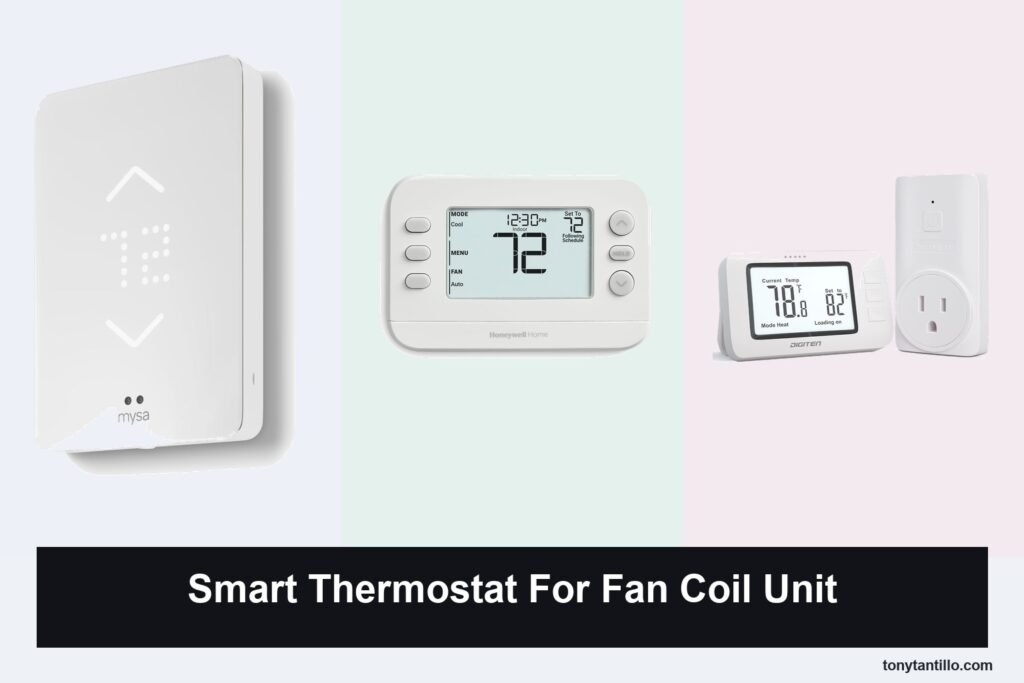
A smart thermostat for a fan coil unit has to do more than look modern on a wall. It needs the right electrical compatibility, the right control logic, and enough flexibility to match how the system actually heats or cools a room. When those pieces do not line up, even a well-reviewed thermostat can become a poor fit. The best choices in this category are the ones that match the system first, then add practical convenience through scheduling, remote control, or easier day-to-day operation.
This roundup focuses on three very different paths. One is built for high-voltage electric heating systems and adds smart home controls and adaptive display behavior. One is a conventional programmable thermostat with broad HVAC compatibility and simple installation support. One is a compact plug-and-play temperature controller that uses a remote sensor and straightforward button control. Together, they cover the main decision points most buyers face: wiring, control style, and whether you want a true smart-home thermostat or a simpler temperature manager.
Top Smart Thermostat For Fan Coil Unit on the Market

Mysa Smart Thermostat V2
Best for high-voltage systems
- 120V-240V high-voltage support
- WiFi scheduling
- HomeKit, Alexa, Google
- Adaptive brightness display

Honeywell Home X2P Thermostat
Best budget programmable
- 5-2 day scheduling
- Backlit LCD display
- UWP wall plate
- 2 AA batteries

DIGITEN WTC100 Pro Controller
Best simple controller
- Wireless remote sensor
- Heating and cooling control
- LCD backlight
- Plug and play
Smart Thermostat For Fan Coil Unit Reviews
Mysa Smart Thermostat V2
ADVANTAGES
LIMITATIONS
Mysa is the strongest match here for buyers who need a smart thermostat on a high-voltage electric heating system. Its support for 120V to 240V loads and up to 3800 watts at 240V matters because fan-forced and baseboard-style electric heat often sit outside the reach of conventional low-voltage thermostats. The requirement for at least four wires, including a neutral or second live wire, is equally important. It means this is not a universal swap, but when the wiring fits, the thermostat is designed for the job rather than adapted to it.
The practical payoff is in the control experience. WiFi connectivity, app control, touch control, and support for Alexa, Google Assistant, and Apple HomeKit turn a basic heater control into something you can manage around real routines. Scheduling in less than a minute is useful when you want repeatable heating periods without spending time inside menus. Adaptive Display Technology and adaptive brightness are not just cosmetic. They reduce screen distraction in bedrooms or shared spaces while keeping the thermostat readable when approached.
Against the other two picks, Mysa is the specialist. It is the only option here aimed at high-voltage electric heating, so it should be the first stop when compatibility is the main concern. The Honeywell option is more traditional and better suited to standard 1 heat/1 cool systems, while the DIGITEN controller is simpler and more general-purpose. Choose Mysa if the system match is right and smart-home control matters. It is the clear recommendation for buyers who want a modern thermostat on electric heat rather than a compromise.
Honeywell Home X2P Thermostat
ADVANTAGES
LIMITATIONS
Honeywell Home X2P is the most straightforward choice for buyers who want a familiar programmable thermostat instead of a connected control platform. The 5-2 day scheduling format is the core advantage because it gives weekday and weekend structure without requiring a more complex interface. The backlit display and clear font matter in daily use because they keep temperature and programming visible at a glance. Change filter reminders and custom display settings also make it easier to keep the system organized over time.
Its compatibility is narrower than its broad utility might suggest. This thermostat is built for 1 heat/1 cool, 750 mV, hot water heat, and forced air systems, including gas, oil, or electric. It does not work with electric baseboard heat at 120V to 240V, which removes it from the same job as the Mysa model. The UWP wall plate simplifies installation and future upgrades, while the need for two AA batteries keeps wiring demands lower than many smart alternatives. That makes it a practical replacement choice for standard systems rather than a universal one.
Relative to the other two products, the X2P sits in the middle on both price and capability. It lacks the app-driven flexibility of a WiFi thermostat and the remote-sensor simplicity of the DIGITEN unit, but it delivers a balanced feature set for conventional HVAC setups. The 32°F low-heat setpoint is worth noting for spaces that need low-temperature control, and the 1-year warranty adds a predictable ownership horizon. It is the best recommendation here for buyers who want a dependable programmable thermostat without stepping into a smart-home ecosystem.
DIGITEN WTC100 Pro Controller
ADVANTAGES
LIMITATIONS
DIGITEN WTC100 Pro is the most stripped-down option in the group, and that is its main value. The built-in temperature sensor in the remote controller means the system responds to the air where the remote sits, not just at the receiver. That can be useful in rooms where the appliance itself sits in a poor sensing position. The heating and cooling modes also broaden the device’s usefulness beyond a single seasonal task. For buyers who want direct temperature regulation without app accounts or schedule programming, that simplicity is a real advantage.
The plug-and-play design and three-button operation make it easy to understand quickly. The large LCD screen with backlight improves visibility in darker spaces, and the ability to switch between Celsius and Fahrenheit adds convenience for mixed-user households. Its 110-volt rating and 1650-watt capacity place it in a different lane from the high-voltage Mysa thermostat, while its wireless RF-style control keeps setup less involved than a full programmable wall thermostat. The tradeoff is that this is not a whole-home smart thermostat. It is a straightforward temperature controller.
Compared with the Honeywell and Mysa models, DIGITEN has the narrowest ambition but the least friction. That can be exactly what a buyer wants when the priority is simple automatic temperature regulation rather than scheduling, integrations, or complex wiring. It is also the lightest option here in terms of daily management because the interface is intentionally basic. Choose it when you want direct remote temperature control for a compatible appliance or room setup and do not need a connected thermostat platform. It is the right recommendation for buyers who value simplicity over features.
How to Choose a Fan Coil Thermostat
The right fan coil thermostat is mostly about fit. Some units are made for high-voltage electric heating, while others are built for conventional 1 heat/1 cool HVAC systems or for simple remote temperature control. Before you compare screens, apps, or scheduling, confirm what the system actually needs. Once compatibility is settled, the rest of the decision becomes much easier because you can judge whether you want automation, remote access, or the simplest possible operation.
System Compatibility
Start with the system type, not the feature list. A thermostat that works beautifully on forced air may be useless on electric baseboard heat, and a high-voltage model will not substitute for a standard low-voltage HVAC control. Matching the electrical design is the most important step because it determines whether the thermostat can safely communicate with the equipment at all. If you are not sure, check the voltage, the number of wires, and whether the system is heating only or heating and cooling.
Control Style
Decide how much interaction you want after installation. A programmable thermostat is best when you want fixed schedules and rare manual changes. A connected thermostat adds app-based access, remote adjustments, and smarter automation, which matters if your routine changes often or you want to make temperature changes away from home. A basic remote controller is simpler still. It suits buyers who want automatic control without learning a larger interface or tying the system to a smart-home platform.
Installation Demands
Installation difficulty often tracks with system complexity. Some thermostats rely on wall plates, batteries, or direct replacements that can streamline the swap. Others need specific wiring conditions, such as a neutral or a second live wire, before they can work correctly. Those details affect both the initial install and future maintenance. If you are replacing an older thermostat, pay attention to whether the new unit is designed to simplify upgrades or whether it assumes a more modern wiring layout.
Display and Visibility
Screen quality matters more than many buyers expect. A bright display is useful in hallways and utility spaces, while a backlit or adaptive screen is better in bedrooms and shared rooms where visibility and glare both matter. Large fonts, touch controls, and clearer icons reduce mistakes when you make quick adjustments. If more than one person will use the thermostat, readability can be as important as scheduling. A better display lowers friction every day, not just during setup.
Scheduling and Automation
Scheduling is worth paying for only if you will actually use it. A thermostat with weekly programming can reduce daily manual changes and keep temperatures more consistent. That is useful in homes with stable routines or predictable occupancy. If your schedule shifts often, app control or remote access may matter more than fixed programming. More advanced features like geofencing or energy insights can be helpful, but they should come after compatibility and core control, not before them.
Thermostat Comparison Table
| Product | Best For | Power Type | Control Style | Connectivity | Display | Mounting |
|---|---|---|---|---|---|---|
| Mysa Smart Thermostat V2 | Best for high-voltage systems | 240 volts | App, Touch | WiFi, NFC | LED | Wall Mount |
| Honeywell Home X2P Thermostat | Best budget programmable | Not Specified | Touch | Wired | LCD | Wall Mount |
| DIGITEN WTC100 Pro Controller | Best simple controller | 110 volts_of_alternating_current | Remote | IR | LCD | Wall Mount |
How We Tested & Analyzed Smart Thermostat for Fan Coil Unit
This comparison focused on the factors that actually determine whether a thermostat is a good purchase in this category. Compatibility came first because fan coil and electric heating controls can vary widely in voltage, wiring, and system type. From there, the analysis weighed control method, installation demands, display usability, and automation features. That order reflects how buyers usually live with the product. A thermostat only matters if it can connect correctly, read clearly, and match the household’s preferred level of interaction.
Differences were judged by how they change use over time, not by how many features appear on a spec sheet. Scheduling, app access, wall-plate installation, battery power, and remote sensing all create distinct ownership experiences. Some buyers will value convenience and integration, while others will care more about simplicity and predictable operation. The key question was whether each product’s design aligns with a realistic installation and usage scenario. That makes the comparison more useful than a raw feature count.
Readers should also understand the limits of thermostat shopping in this category. A strong feature set cannot overcome a wiring mismatch, and a low-friction controller does not replace a fully compatible HVAC thermostat. This article therefore emphasizes practical consequences, including what kind of system each model can serve and what kind of user it best suits. Where features were absent, they were left out rather than inferred. That keeps the recommendations grounded in what each thermostat can actually do.
Frequently Asked Questions
How do I know if a thermostat is compatible with my system?
Check the system voltage, the number of wires, and whether the equipment is heating only or heating and cooling. Those details matter more than the thermostat’s style or screen size. A model designed for high-voltage electric heat will not replace a standard HVAC thermostat, and the reverse is also true.
Is WiFi necessary for a fan coil thermostat?
Not necessarily. WiFi is useful if you want app control, remote changes, or smart-home integrations. It is less important if you only need stable local scheduling or basic temperature regulation. For many buyers, compatibility and control style matter more than connectivity.
What is the advantage of a programmable thermostat?
A programmable thermostat reduces repeated manual adjustments by following a schedule you set in advance. That is helpful when your routine is predictable and you want consistent temperatures at certain times of day. If your schedule changes often, a connected or simpler remote-control option may be easier to live with.
Do all thermostats support fan coil or electric heat?
No. Thermostats are usually designed for specific system types, and that is one of the most important distinctions in this category. Some are built for high-voltage electric heat, some for standard 1 heat/1 cool HVAC systems, and some for remote control of compatible appliances. Always match the thermostat to the system first.
Final Thoughts
The best thermostat for a fan coil unit is the one that matches the system without forcing compromises. Once voltage, wiring, and control type are aligned, the rest of the decision becomes a question of convenience. Some buyers will want app control and smart-home integration. Others will be better served by a familiar programmable interface or a simpler remote controller. Each of the three options here has a clear role, and that clarity is more useful than trying to compare them as if they were interchangeable.
Choose the thermostat that fits the way your space is actually used. If compatibility with high-voltage electric heat is the problem, the specialist smart model stands out. If you want a conventional schedule with easy readability, the programmable option is the safer path. If you only need straightforward automatic control without extra complexity, the remote temperature controller is the most direct choice. That is the most reliable way to buy well in this category in 2026.